Blog
36V UTV for Kids: 2-Seater vs. 1-Seater, What’s the Difference

Big news first: the 36V one-seater UTV is now available on our site. So — what's the difference between it and our 36V two-seater, the one that's already the better-known of the two?
Hey, one seat versus two seats. That sounds like a five-second answer, and honestly, it is the core difference. But here's the thing: that one design decision ripples outward. It's why one has a storage box and the other doesn't. It's why one seat slides back and forth and the other one doesn't. It's why one is quicker, and why one can still fit your kid three summers from now.
Understand those ripples and you'll pick the right one the first time. That matters when the rider is six, or nine, or about to hit a growth spurt — because the wrong pick means either a vehicle nobody uses or a vehicle that gets outgrown in a year.
Let's start with what these two share.


First, What the 36V 2-Seater and 1-Seater Have in Common
| Shared spec | Both models |
| Battery | 36V 9Ah |
| Motors | Dual 200W |
| Recommended age | 6+ |
| Load rating | 132 lb (60 kg) — total on the 2-seater, per rider on the 1-seater |
| Remote control | None — deliberate, these are self-drive machines |
| Controls | Hall-effect variable throttle pedal + electronic brake pedal |
| Drive | Forward / reverse, soft start & soft stop |
| Tires | EVA foam (not hard plastic) |
| Suspension | Dual rear spring suspension |
| Frame | Reinforced metal |
| Audio | Bluetooth music |
| Runtime | 45–60 min on hard ground, 25–45 min on grass (at a 60 kg load) |
| Charging | 8–12 hours on the included 36V 1000mA charger |
What that shared list means in plain terms
Nothing on the “important” list is a compromise. Power, controls, tires, suspension, frame, running cost — identical. You're not choosing between a good one and a cheaper one. You're choosing between two bodies sitting on the same platform. That's worth pausing on, because most kids UTV shopping is really about spotting what got cut. Here, nothing did.
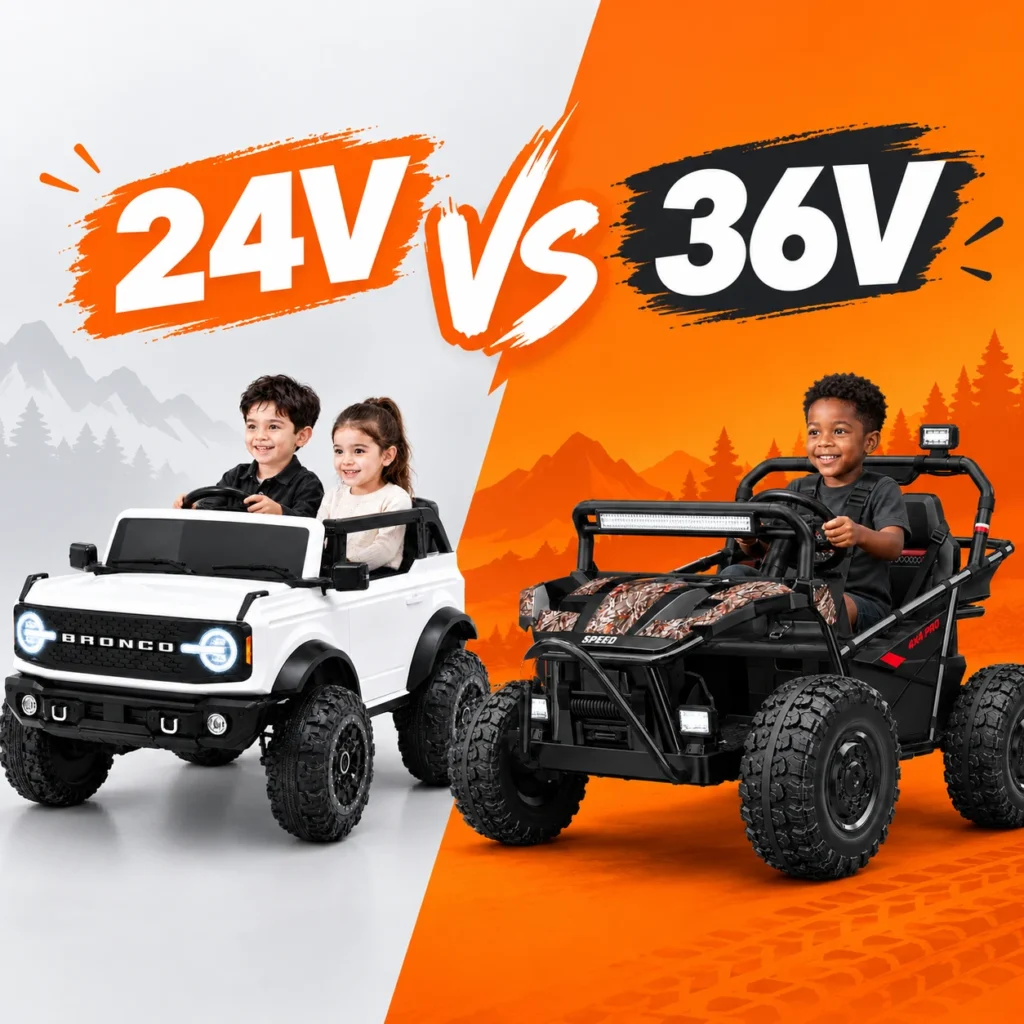
- The power is real, not toy-grade. Dual 200W motors on a 36V 9Ah pack is roughly double the motor output of a typical 24V ride-on. You notice it in the two places that matter: pulling away from a stop, and holding speed through thick grass instead of fading. If you want the long version of why voltage matters more than motor count, we broke it down in our 24V vs. 36V ride-on car guide.
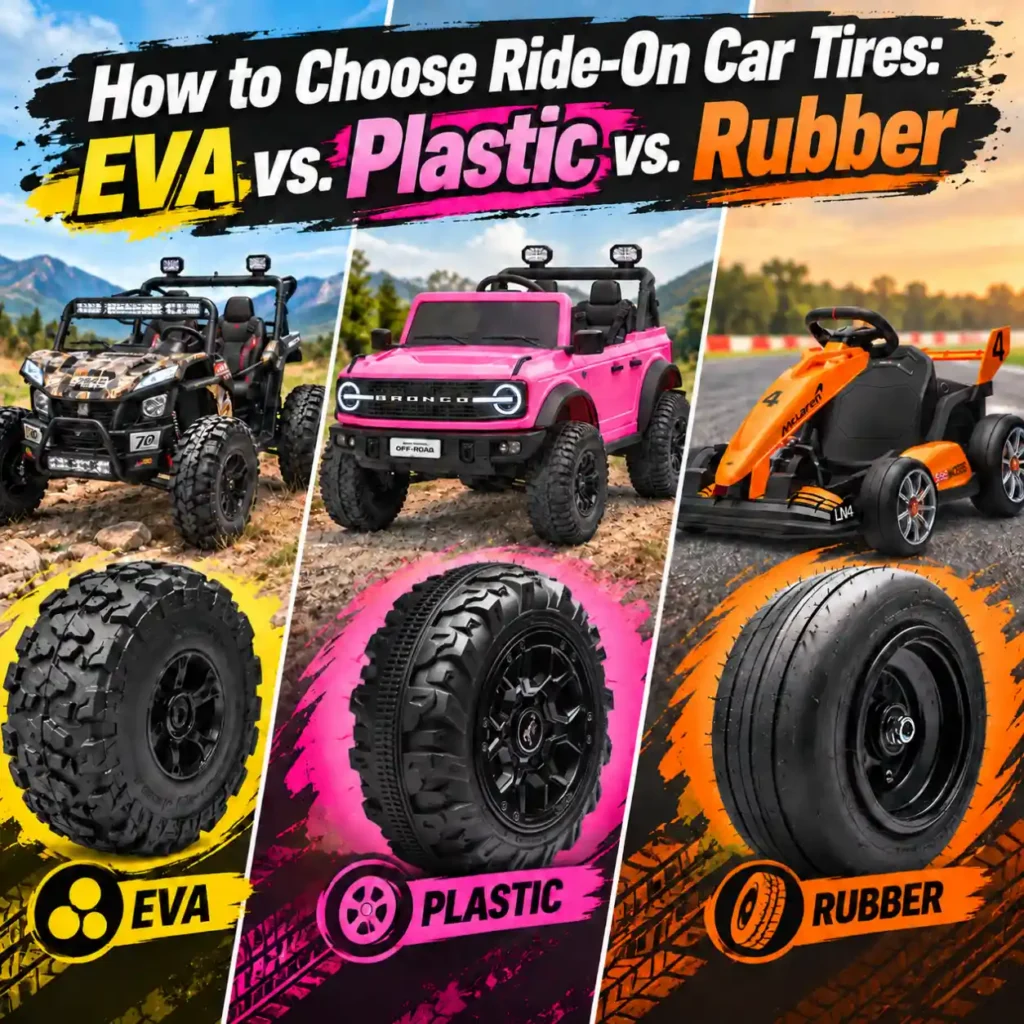
- Both handle the same ground. EVA foam tires plus dual rear spring suspension is what makes grass, gravel and packed dirt feel smooth instead of rattly — and why neither one rattles itself loose after a season. The full explanation of foam vs. plastic vs. rubber is in our ride-on tire guide.
- Both run the same 45–60 minutes on hard ground and both ask the same of you: plug in overnight, ride the next day. Same 8–12 hour charge, same charger.
- Both are yard-and-trail vehicles. Neither is street-legal, and both should stay away from traffic.
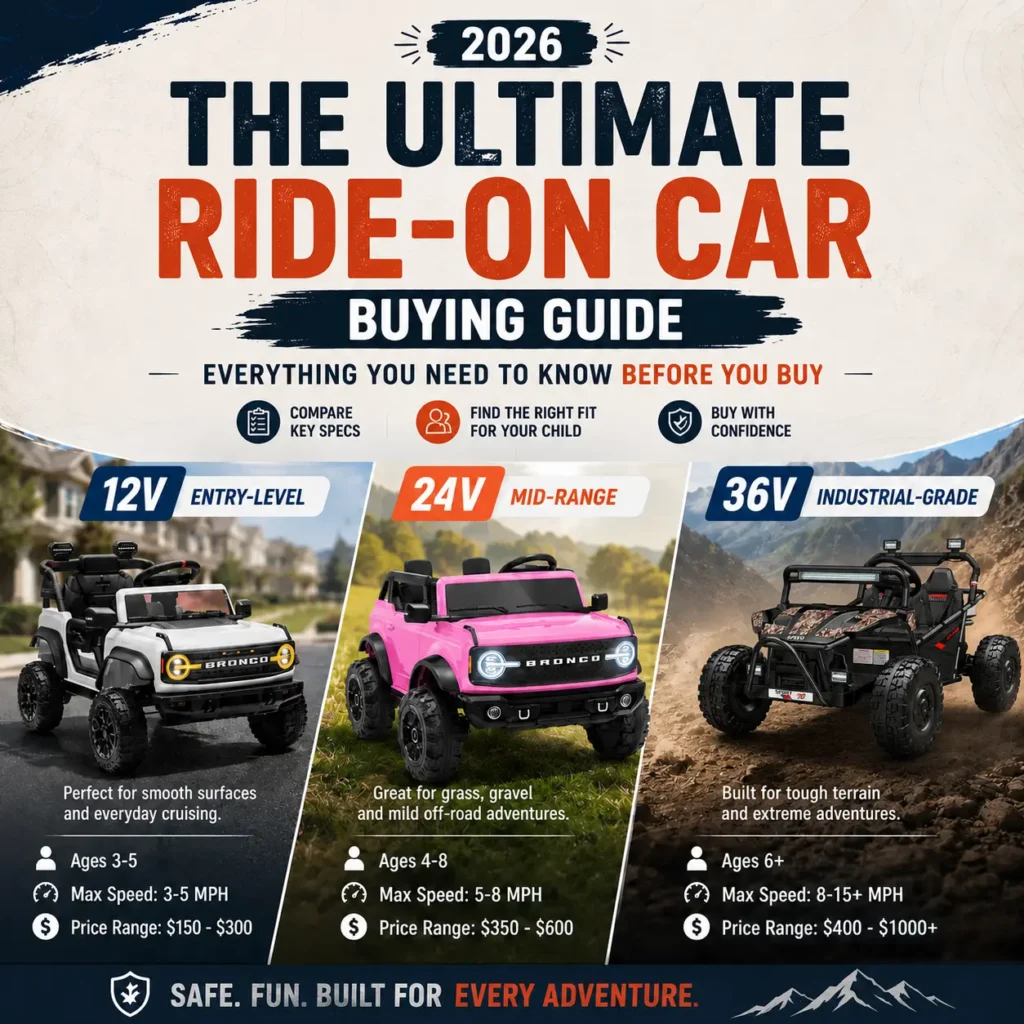
- Both are built for kids who drive themselves. No parental remote on either, on purpose. Parents stay involved through the low/high speed setting, soft start/stop, and the brake pedal. If you want remote takeover, a 12V or 24V model is the right first car.
The Differences between 36V 2-Seater VS 1-Seater
| 36V 2-Seater | 36V 1-Seater | |
| Seats | Two on a 52 cm (20.5″) bench, fixed | One bucket seat, 3-position adjustable |
| Safety belts | Three-point belt at each seat | Two-point harness |
| Top speed | 9–14 km/h (5.6–8.7 mph), 2 settings | 11–15 km/h (6.8–9.3 mph), low/high |
| Rider capacity | 132 lb (60 kg) total across the bench | 132 lb (60 kg) per rider, up to 1.6 m (5 ft 3 in) |
| Storage | 54 × 16 × 12.5 cm rear cargo box | None |
| Tires | 35 cm (14″) EVA all round, 12 cm wide | Front 250 mm (9.8″), rear 300 mm (11.8″) |
| Lights | Dual headlights + windshield light bar + two rear lights | Headlight + roof-mounted spotlights |
| Vehicle size | 140 × 88 × 80 cm (55″ × 35″ × 31″) | 128 × 73 × 58.5 cm (50″ × 29″ × 23″) |
| Vehicle weight | 39.1 kg (86 lb) | 27.7 kg (61 lb) |
| Price | $469.99 | $399.99 |
1. Seats: a fixed bench vs. a seat that moves
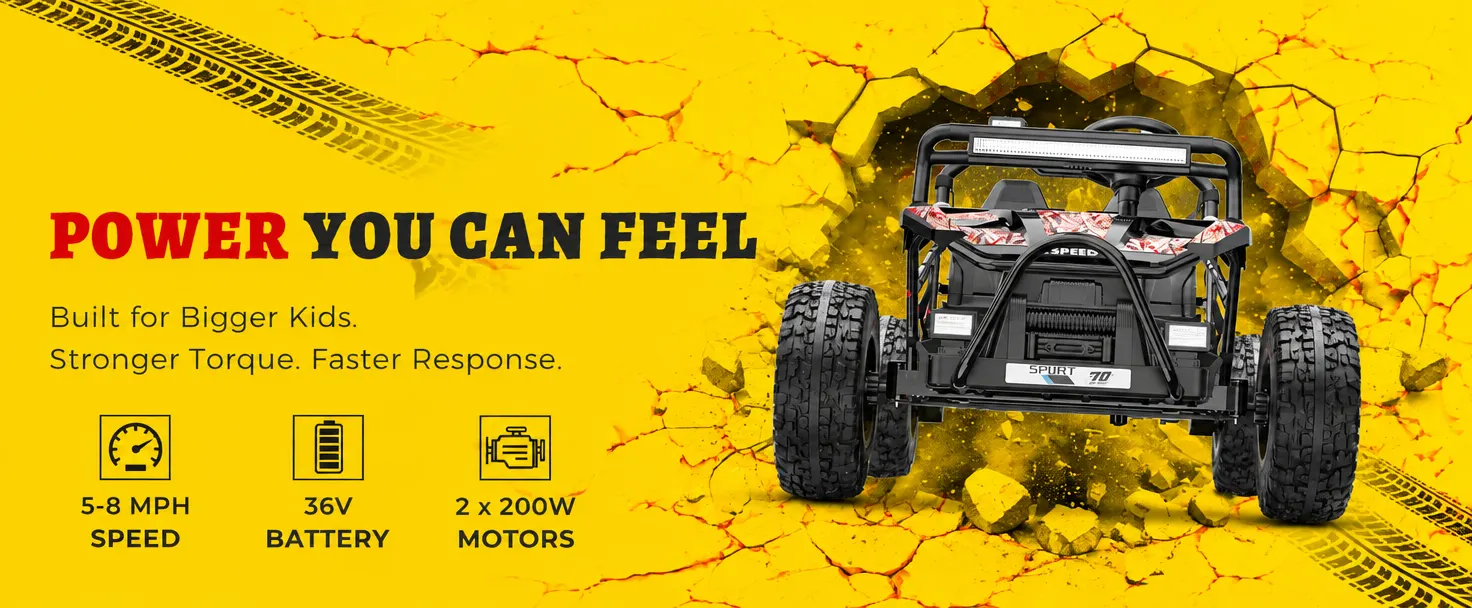
The difference: the 2-seater uses one 52 cm bench, 22 cm deep with a 30 cm backrest — sized so two kids sit side by side instead of one sitting half-sideways. The 1-seater uses a single bucket seat with three adjustment positions.
Why it's built this way: a bench is the most space-efficient way to seat two children in a given width — no rails, no mechanism, no gap between two separate seats. The single seat has the opposite problem to solve: it serves one rider who is going to grow from maybe 6 to 11, up to 1.6 m (5 ft 3 in) tall. When a kid grows, what actually stops feeling right isn't the seat width, it's the distance from the seat to the pedals and the wheel. So the seat slides back — that's what keeps the driving position workable for years.
What it means for you: if you're buying for two kids at the same time, the bench is simply the only way both ride. If you're buying for one kid who will keep riding for years, the adjustable seat is what stops the UTV being retired at eight.
2. Storage: why the 2-seater has a cargo box and the 1-seater doesn't
The difference: the 2-seater carries a 54 × 16 × 12.5 cm box behind the seats. The 1-seater has no storage box.
Why it's built this way: think about who's riding and what they're carrying. The 2-seater is a family vehicle — two kids plus the stuff that comes with two kids. It's also the longer vehicle (140 cm vs 128 cm), so there's room behind the rear axle for a box without stretching the footprint further. The 1-seater is a compact one-person machine: the bucket seat reclines, the battery sits behind it, and the body ends shortly after. There's no leftover space, and with one rider there's no second passenger's gear to carry in the first place.
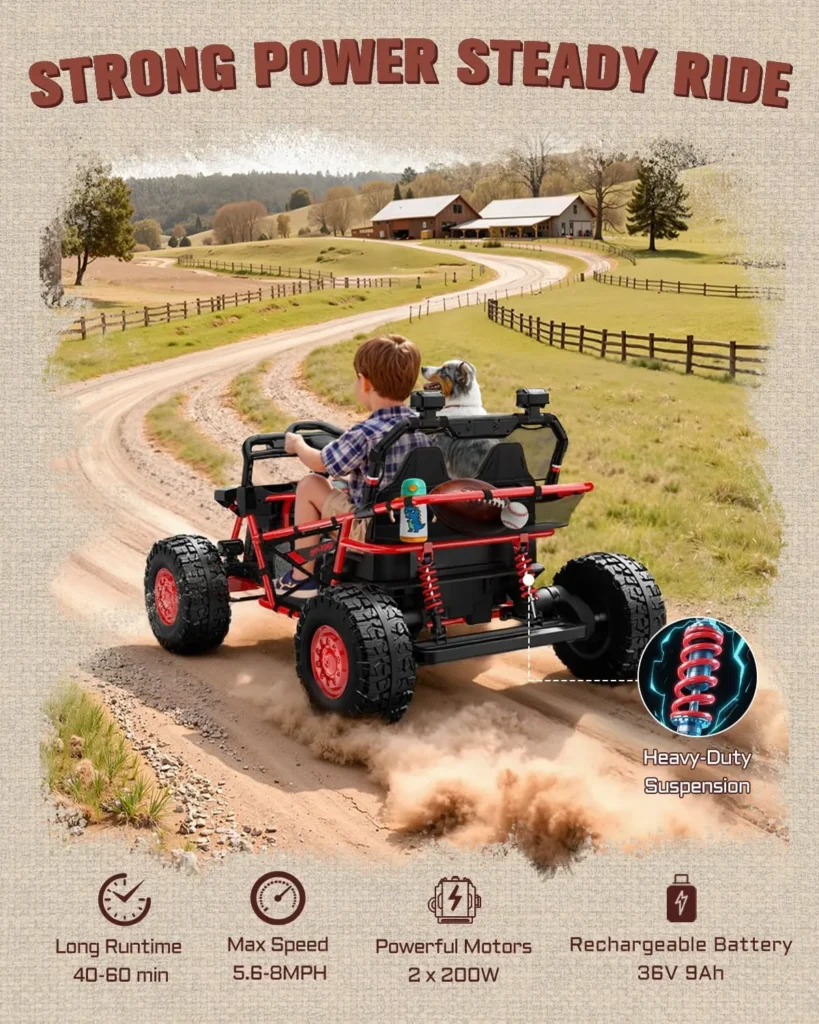
What it means for you: with the 2-seater you can head out empty-handed — water bottles, snacks and the day's toy haul ride in the back instead of on a lap. With the 1-seater, plan on a backpack or a pocket; that's the trade for a body this compact.
3. Tires: big and even, or small in front and wide at the back
The difference: the 2-seater runs 35 cm (14″) EVA tires all round. The 1-seater runs a 250 mm (9.8″) front and a 300 mm (11.8″) rear — smaller in front, bigger at the back.
Why it's built this way: weight decides tire size. The 2-seater is 39.1 kg empty and can be carrying close to 100 kg with two riders aboard — bigger diameter and a wide contact patch are what keep rolling resistance and ground pressure down, so it doesn't sink or bog on grass. The 1-seater is 11 kg lighter and carries one rider, so it doesn't need the same footprint. What it uses instead is a classic go-kart layout: a small front wheel steers more lightly and turns quicker, while the wider rear wheel puts more rubber on the ground where the drive actually happens.
What it means for you: the 2-seater feels planted and steady with two kids aboard. The 1-seater steers more nimbly and turns in a smaller circle — one rider, one set of hands on the wheel.
4. Speed: the lighter one is faster — same motors, less weight
The difference: the 2-seater tops out at 14 km/h (8.7 mph) across two settings. The 1-seater reaches 15 km/h (9.3 mph) on its high setting, with a low setting around 11 km/h (6.8 mph).
Why it's built this way: both run the identical dual 200W motor setup, so the speed gap isn't an engine difference — it's an 11 kg weight difference. A lighter vehicle accelerates harder and reaches a higher top speed on the same power. On top of that, a two-passenger vehicle has more weight higher up and needs more distance to stop, so its factory settings stay a step more conservative.
What it means for you: don't buy the 1-seater expecting a rocket and the 2-seater expecting a slug. The gap is about 1 km/h at the top end. The 1-seater is the quicker of the two; the 2-seater is tuned for two riders rather than for the stopwatch.
5. Safety belts: three-point each vs. a two-point harness
The difference: the 2-seater gives each seat its own three-point belt. The 1-seater uses a two-point harness.
Why it's built this way: a three-point belt needs a shoulder anchor point, and a bench with an upright backrest is the natural place to put one. A bucket seat is shaped differently — it wraps the rider with side bolsters and a deeper seating position, so a lap belt plus the seat's own shape does the restraining. The bucket also sits lower, which is part of why it's easier to get in and out of.
What it means for you: both keep a rider in place on bumpy ground. The 2-seater's three-point belts are the better answer for two kids sitting shoulder to shoulder who wiggle; the 1-seater's harness is quicker for one kid to buckle themselves.
6. Size and weight: 39.1 kg vs. 27.7 kg
The difference: the 1-seater is 12 cm shorter, 15 cm narrower and 21.5 cm lower — and 11.4 kg lighter. For context, that weight gap is about the same as a two-year-old.
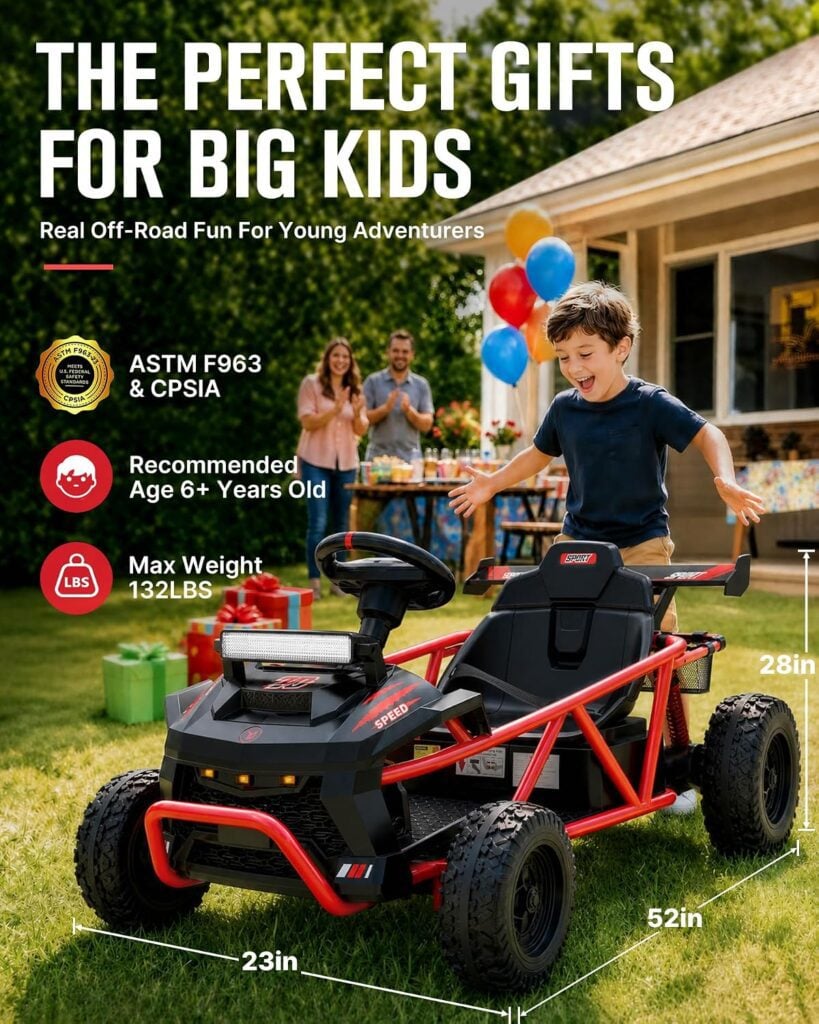
Why it's built this way: remove the second seat, shorten the chassis, drop the roofline, and the weight follows. Nothing exotic — the 1-seater is simply the same idea built for one.
What it means for you: Loading it — both fit a typical SUV or truck bed, but the lighter one is a much easier lift. If your storage is tight or you'll be the one hauling it, this alone can decide it.
7. Lights: being seen vs. seeing ahead
The difference: the 2-seater has dual front headlights, a full-width windshield light bar and two rear lights on the backrest. The 1-seater has a headlight plus roof-mounted spotlights.
Why it's built this way: the 2-seater's lighting is about the whole vehicle being visible — front and back — which is what matters when two kids are riding together into the evening and there's more vehicle to notice. The 1-seater's setup points forward and upward, matching a single rider finding their own way along a path.
What it means for you: if late-afternoon rides are a regular thing in your house, the 2-seater is the more visible vehicle all round. Either way, plan to finish before full dark — these are backyard and trail machines, not road vehicles.
8. Price: $70 apart
$469.99 for the 2-seater, $399.99 for the 1-seater. The $70 difference buys a second seat, the cargo box, the bigger wheels and the fuller lighting package — which is a fair summary of everything above.
So What's the Core Difference? (The One-Sentence Answer)
One seat or two is the whole story — everything else is downstream of it.
The 2-seater is a shared vehicle: it's built so two kids can ride together, which is why it's longer, heavier, geared for passengers, and comes with cargo space for two kids' worth of stuff. The 1-seater is a personal vehicle: it's built so one kid can keep riding as they grow, which is why it's compact, light, adjustable and quicker.
Put another way: pick the 2-seater when the question is “who gets to ride with whom”, and pick the 1-seater when the question is “what will my kid still be riding in three years”. Both are the same machine underneath — you're really choosing a seating arrangement. Most kids UTV comparisons come down to specs; this one comes down to a seating plan.
So found the right ride-on car for your kid? Get it at First Ride On!
FAQs about 36V One-Seater UTV VS Two-Seater UTV
Is the 132 lb weight limit per seat or total on the 2-seater?
Total, across the whole bench. The 2-seater is rated for 132 lb (60 kg) combined — two lighter kids adding up to that, or one bigger rider. The 1-seater's 132 lb (60 kg) is a single-rider figure, with a 1.6 m (5 ft 3 in) height cap on top. Same number, different meaning — worth checking before you buy for two big kids.
Can two kids ride the 1-seater?
No. It's a single bucket seat rated for one rider. Two kids riding together need the 2-seater's bench and its two belts.
How fast do they go?
The 2-seater runs 9–14 km/h (5.6–8.7 mph) across two settings. The 1-seater runs a low setting around 11 km/h (6.8 mph) and a high setting up to 15 km/h (9.3 mph). Start any new rider on the lower setting.
Do either of them have a parental remote?
No — and that's a design decision, not a missing part. Both are rated for ages 6+ and built for kids who drive themselves: variable throttle pedal, electronic brake, forward/reverse. Parents stay in the loop through the speed settings and soft start/soft stop. If you'd rather be able to take over by remote, our 12V and 24V ride-ons all include one.
How long does the battery last?
Both run 45–60 minutes on hard ground with a 60 kg load, dropping to 25–45 minutes on grass, which pulls more current. Charging takes 8–12 hours on the included charger — overnight is the routine.
Why does the 2-seater have a storage box but the 1-seater doesn't?
Because of who's riding. The 2-seater is a family vehicle carrying two kids plus their gear, and it's 12 cm longer, so there's space behind the seat. The 1-seater is a compact single-rider machine with the battery occupying the space behind the seat — nowhere to put a box, and no second passenger's gear to carry.
Is a 36V UTV too fast for a 6-year-old?
Both are rated for ages 6+, and both have a low speed setting for exactly this reason. A 6-year-old starts on low in an open area and moves up once steering and braking are consistent. If your child has never driven solo, a remote-equipped 12V or 24V model is the gentler first step.
Which one is easier to store and move?
The 1-seater, clearly: 27.7 kg against 39.1 kg, and 12 cm shorter, 15 cm narrower and 21.5 cm lower. One adult can move the 1-seater alone; the 2-seater is a two-hand job.
What size and weight child does each 36V UTV fit?
36V 2-Seater — two riders, ages 6+. The seat is one 52 cm (20.5″) bench, 22 cm (8.7″) deep with a 30 cm (11.8″) backrest, and each position has its own three-point belt. The 132 lb (60 kg) rating is the combined total for the whole bench — so plan on roughly 66 lb (30 kg) per child.
36V 1-Seater — one rider, ages 6+. The seat is a 35 × 27 × 29.5 cm (13.8″ × 10.6″ × 11.6″) bucket seat, and its 132 lb (60 kg) is per rider, with a published height limit of 1.6 m (5 ft 3 in). That's a wide window: a 6-year-old and an 11-year-old both fit, and the 3-position seat keeps the pedals within reach as they grow.