Blog
2026 The Ultimate Ride-On Car Buying Guide: Everything You Need to Know Before You Buy

When shopping for a children’s ride-on car, many parents are easily drawn by flashy appearances and overwhelming marketing claims. However, what truly determines a vehicle's performance, durability, and safety is hidden beneath the surface in its core technical specifications.
Whether it is for daily cruising on smooth neighborhood pavement or conquering all-terrain grass and slopes, varying specifications in motor power, battery voltage, tire materials, and suspension systems deliver entirely different driving experiences.
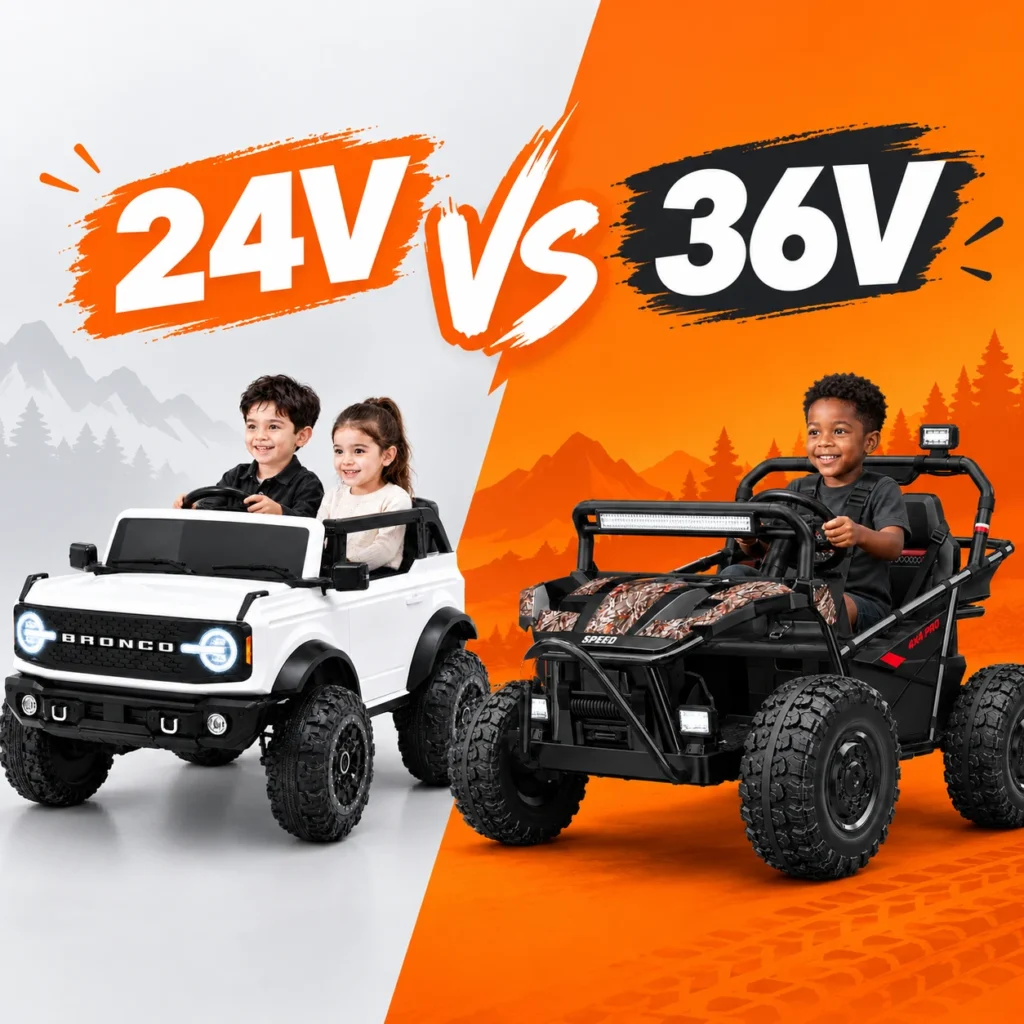
To help parents cut through the marketing noise, this guide strips away superficial gimmicks to focus on a breakdown of foundational hardware specs—such as voltage, motors, chassis, and safety features—followed by a comprehensive, side-by-side comparison of mainstream 12V entry-level models, 24V mid-range models, and 36V industrial-grade UTVs.
If you want to understand the true practical significance behind these technical specs and choose a well-matched, safe, and high-value vehicle for your child, read on.
Part 1: The Core Anatomy — Understanding the Specs That Matter
When evaluating a ride-on vehicle, specifications can quickly become alphabet soup. However, looking past the cosmetic styling, performance and longevity come down to four foundational hardware pillars. Here is a breakdown of what these specs actually mean and how they directly impact your child's driving experience.
1. Motors & Voltage (12V vs. 24V vs. 36V) Voltage and motor configuration serve as the primary power source of any ride-on vehicle. They dictate not only top speed, but more importantly, torque and terrain capability. Voltage (V) measures the electrical potential driving the system, while the motors convert that energy into wheel rotation. In practice, 12V systems are best suited for flat surfaces like pavement and indoor runs, ideal for younger children ages 3–5. 24V systems deliver a noticeable step-up in climbing power and torque to comfortably handle mild slopes, short grass, and gravel. 36V systems provide strong torque to effortlessly conquer steep inclines, thick grass, and uneven off-road tracks while sustaining consistent speeds under heavier loads.
2. Chassis & Suspension (Frame Integrity & Shock Absorption) A vehicle's frame and suspension determine how well it handles physical stress and uneven terrain. The chassis refers to the core structural framework (often reinforced resin, steel tubing, or heavy-duty composite plastics), while the suspension system involves spring-loaded shocks on the front and/or rear axles. A rigid, well-designed chassis prevents the body from warping or cracking when rolling over bumps or carrying maximum weight capacities. Furthermore, quality spring or hydraulic suspension absorbs the kinetic energy from rocks and curbs, preventing rough impacts from transferring directly up through the seat, which protects the rider's joints and reduces strain on the vehicle's electrical connections.
3. Tires & Traction (EVA Foam vs. Pneumatic Rubber) Tires are the only point of contact between the vehicle and the ground, making them critical for safety, traction, and overall riding comfort. While plastic tires are loud and prone to slipping, pneumatic rubber tires offer maximum grip and superior shock absorption for extreme off-road environments; however, they come with a major catch for everyday family use—they require inflation and carry the constant risk of punctures or slow leaks from sharp stones, making them high-maintenance and typically reserved for specialized heavy-duty builds. In contrast, EVA foam tires are lightweight, puncture-proof, and entirely maintenance-free, striking the ideal balance for most families. They offer quiet, reliable traction on pavement and light grass without the headache of flat tires, making them the gold standard and industry favorite for high-quality ride-on vehicles.
4. Safety Systems (Multi-Point Harnesses & Soft-Start Mechanism) Power is meaningless without control. Modern ride-on safety technology is designed not just for compliance, but to actively protect both the young rider and the vehicle's transmission in real-world conditions. Regarding physical restraint, conventional ride-on cars often rely on basic single-lap belts or loose straps that fail to prevent a child from pitching forward during sudden stops. In contrast, premium models upgrade to 3-point or 5-point harnesses. While a 3-point harness distributes impact forces across the shoulders and lap, the racing-inspired 5-point harness locks the rider securely at the shoulders, hips, and between the legs, entirely eliminating the risk of a child slipping, sliding out, or suffering secondary impact injuries. Simultaneously, high-torque motors can produce an aggressive initial jolt, but soft-start technology regulates power delivery for a smooth, progressive takeoff. This mechanism provides vital dual protection: it eliminates the jarring jerk of sudden acceleration to keep young riders from getting startled and protect their sensitive necks from excessive strain, while giving the child a manageable window to adjust to the motion to prevent runaway crashes, simultaneously reducing electrical and mechanical stress to extend the gearbox's lifespan.
Part 2: The 12V Entry-Level Tier (Standard Cruisers & Classic Cars)
The 12V tier serves as the foundational entry point for young children, typically targeting ages 3 to 5, and is engineered for everyday, light-duty use in controlled domestic environments. Its foundational electrical architecture usually relies on a single 12V lead-acid battery (ranging from 4.5AH to 7AH capacity) driving single or dual basic gearboxes. Common specifications include budget-friendly standard plastic tires or entry-level lightweight EVA foam tires, basic front/rear spring shocks or rigid setups, and a strictly controlled top speed averaging 2 to 4 mph. Most models in this tier feature standard single-lap restraints or simple straps alongside basic multi-speed switches, focusing entirely on a safe, manageable introductory driving experience.
Priced accessibly between $150 and $300, this represents the most widely mass-produced segment of the market. They are best suited for smooth driveways, flat concrete sidewalks, indoor playrooms, and lightweight toddlers taking their first steps into motorized driving. Because their motor torque and discharge output are deliberately conservative, lacking the explosive power required to overcome surface resistance, they are strictly designed for flat, paved surfaces and will inherently struggle or stall on grass, sand, or inclines.
Part 3: The 24V Mid-Range Tier (Performance Off-Roaders & Two-Seater SUVs)
Stepping up to a 24V system marks a definitive transition from casual toys to genuine performance ride-ons, designed for older children ages 4 to 8 and more adventurous outdoor environments. The electrical system utilizes series-connected or high-capacity 24V power sources (typically 7AH to 10AH configurations), powered by robust dual or quad independent drive systems featuring larger, thermally optimized 550 or 775-type high-output motors. Common specifications include upgraded full-size EVA foam tires, multi-stage spring or hydraulic composite suspension, and top speeds scaling up to 5 to 7 mph. Crucially, this tier introduces secure 3-point safety harnesses, digital media consoles, and advanced 2.4G parental remote overrides featuring multi-tier speed adjustments and instant brake overrides.
Generally retailing between $350 and $600, this price point reflects substantial engineering upgrades in motor wattage, battery endurance, harness gauge thickness, and overall structural integrity. They are exceptionally well-suited for backyards with short grass, gravel pathways, mild slopes, and uneven neighborhood terrain, as the doubled voltage and high-torque gearboxes deliver the necessary climbing power and sustained force to prevent stalling on moderate inclines, ensuring older children enjoy dynamic performance.
Part 4: The 36V Industrial-Grade Tier (Heavy-Duty UTVs & Extreme Performance Buggies)
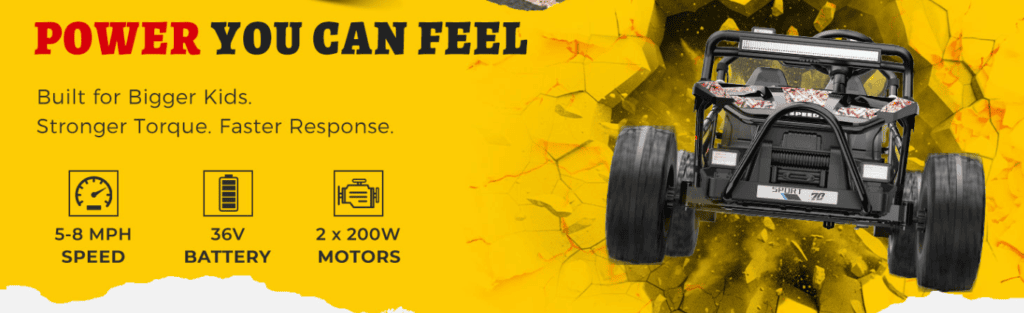
At the pinnacle of the ride-on market sit the 36V industrial-grade UTVs and high-end off-road buggies, bridging the gap between children's toys and junior motorsport vehicles for older, larger kids and demanding terrains. Hardware specifications feature advanced 36V high-capacity power systems paired with heavy-duty high-torque motors—frequently evolving toward high-efficiency, low-heat brushless motor layouts. They utilize large-diameter EVA wheels or true pneumatic rubber tires for maximum mechanical grip, paired with heavy-duty adjustable suspension, pushing speeds up to 5 to 8+ mph.
Key Buyer Consideration: Navigating high-torque 36V power through aggressive off-road environments pushes physical restraint requirements to their absolute peak. Unfortunately, many brands on the market still refuse to invest in proper multi-point safety for these heavy-duty models, settling for cheap, basic lap belts. When evaluating 36V options, parents should treat the presence of a robust 3-point safety harness as a crucial litmus test for build quality and safety commitment. By securing both the lap and shoulders, paired with linear soft-start acceleration chips, reinforced steel tubular frames, and emergency power-cut protection, this guarantees a secure shield for older, more adventurous children.
Positioned at the market tier from $400 to $700 (with select oversized or premium lithium-powered models reaching $800–$1,000+), these machines are built for robust durability and performance. They are engineered specifically for expansive rural properties, thick grass, deep gravel, mud tracks, steep hills, and rugged off-road trails. Delivering strong torque and relentless power delivery, they guarantee that heavier or older children navigating demanding, uneven terrain never experience performance drop-offs or power starvation.The 36V 2-Seater Electric Off-Road UTV delivers powerful performance and is equipped with features such as EVA tires, three-point seatbelts, and a soft-start pedal, meeting children's driving needs while ensuring their safety.
Conclusion: Making a Smart Investment in Every Adventure
Choosing the right ride-on vehicle is about much more than picking out a toy—it is about providing a secure foundation for your child's outdoor explorations and early driving milestones. From 12V entry-level cruisers tailored for smooth driveways and 24V performance vehicles built for multi-terrain fun, to 36V industrial-grade UTVs engineered for extreme off-road trails, each tier represents a deliberate step up in motor power, frame integrity, tire traction, and physical restraint.
As you navigate the market, look past the superficial cosmetic styling and focus on the hard hardware details that truly dictate safety and longevity—such as verifying whether robust multi-point safety harnesses and soft-start systems match the vehicle's surging power output. We hope this guide helps clear away the specification clutter, empowering you to choose the safest, highest-performing ride-on that will deliver endless thrills and unforgettable childhood memories.