Blog
How to Choose Ride-On Car Tires: EVA vs. Plastic vs. Rubber

If you're picking out your child's first ride-on car, you're probably focused on battery voltage, seats, the parental remote, and how the vehicle looks. Beyond those specs, the tire material also tells you whether a car fits your child — and why it's priced the way it is. In our other blog on how to choose a ride-on car, we also briefly cover power-wheels tires. In this blog, we will walk you through the different types of tires, so you’ll know how to choose the right ride-on toy based on the tires.
Ride-on tires come in three main materials: plastic (PP) wheels, EVA foam, and rubber. PP plastic works well on flat pavement and driveways, while EVA foam and rubber give better grip and cushioning on grass, dirt, gravel, and uneven ground.
So before you choose a ride-on, think about where your little driver will actually explore. Let's dig into the differences between these wheel materials.
The Quick Answer: Match the Tire to the Terrain
- Flat pavement, sidewalks, driveways: PP plastic — a practical, low-maintenance choice.
- Grass and dirt: EVA foam or rubber gives more grip and a softer ride.
- Gravel and gentle slopes: EVA or rubber helps absorb bumps and hold traction.
- Big-kid motos and karts: rubber or air-filled tires, when grip and cushioning matter more.
What Materials Do Ride-On Tires Use?
A tire compound (also called the wheel material) is the part of the wheel that touches the ground [1][2][3]. This material shapes the whole driving feel — grip, noise, rolling resistance, and cushioning.
You'll usually see these materials on ride-on toys:
- PP plastic — polypropylene, a hard molded plastic
- EVA foam — ethylene-vinyl acetate copolymer, a lightweight foam
- Rubber — used in both solid and air-filled (pneumatic) tires
- You may also see TPE, TPR, PU, or mixed-material wheel designs. These give ride-on cars different levels of softness, grip, durability, and noise control.
Summary Table: Ride-On Tire Materials at a Glance
| Material | Key characteristics | Pros | Cons | Used on what vehicles | Price positioning | Best for |
|---|---|---|---|---|---|---|
| PP plastic | Hard, rigid (Shore D 80–95), light, low rolling resistance, no air [1][9] | Cheap, near-indestructible, zero maintenance, low rolling resistance on pavement | Loud on hard ground, no cushioning, slips on wet grass / steep slopes [9] | Most trucks, UTVs, push cars | Most affordable | Flat pavement, daily driveway / sidewalk use |
| EVA foam | Soft closed-cell foam, high friction coefficient, lightweight [2][6][7] | Quiet, grippy on grass / dirt, never flats, no inflation | Wears faster on rough hard ground, can't be patched [13][14][15] | Off-road-leaning builds (a few models) | Mid | Grass, dirt, neighborhood mixed terrain |
| Rubber / air-filled | Elastic; pneumatic uses air to absorb shocks, solid rubber gives without air [4][10] | Best cushioning, real traction on loose / uneven ground, stable at speed | Can puncture (air-filled), heavier, pricier [4][10] | Performance motos and karts | Higher (performance tier) | Rough terrain, high-speed bigger-kid rides |
| TPE / TPR | Rubber-plastic blend, Shore A 60–75, softer than PP [11][12] | Quiet, grippy, a practical middle ground | Less common, performance varies by formula | A few models (e.g., one 24V two-seater) | Mid-to-higher | Quieter, grippier step above PP |
| Mixed (PU / PA / PP) | Softer tread over rigid hub — “hub gives structure, tread gives grip” [11][12] | Combines structure + grip, some with glow / flair | Not user-swappable | A few karts | Mid-to-higher | Specialized play (drift, glow) |
The sections below are the detailed version of this table.
PP Plastic Wheels: The Simple, Low-Cost Choice
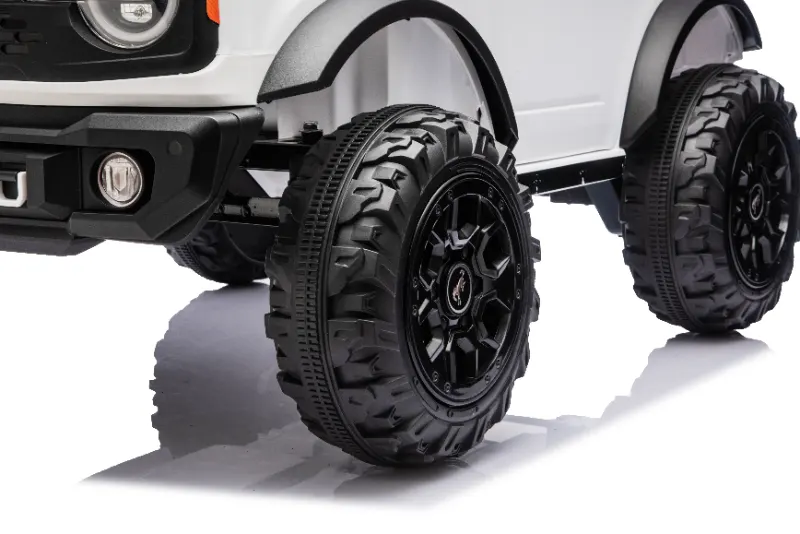
Polypropylene (PP) is a thermoplastic commonly used to make hard molded products, including wheels [1].PP Plastic Wheels: The Simple, Low-Cost Choice
Key characteristics of PP: it is hard and rigid (about Shore D 80–95), lightweight, has low rolling resistance, needs no inflation, resists chemicals, and is cheap to mold — which is why PP tires need almost no maintenance.
Why are PP wheels so common?
- They work well on smooth, hard surfaces.
- They have relatively low rolling resistance on pavement [9].
- They need no inflation or patching.
- They're durable and easy to maintain.
- They help keep ride-on cars affordable.
Industrial caster comparisons confirm PP wheels have low rolling resistance and low cost, but weaker shock absorption and quietness than softer wheel materials [9].
What are the downsides?
- Hard plastic can be louder on hard surfaces.
- It cushions bumps poorly.
- Its grip drops on wet grass or other slippery surfaces.
That doesn't make PP a bad choice. For a child who mostly rides on the driveway, sidewalk, or patio, a ride-on with PP wheels can be a very practical pick. That's also why PP is currently the most common wheel material on electric ride-on toys.
EVA Foam Wheels: Quieter and Softer
EVA — ethylene-vinyl acetate copolymer — is a thermoplastic copolymer used in products that need some flexibility and cushioning. EVA foam is also widely used in shoe soles and flooring [2][6].
Many ride-on toys use closed-cell EVA foam — tiny sealed bubbles inside the material. That makes the wheel feel soft without needing air [7]. EVA is also non-toxic and recyclable [8].
Why choose EVA ties ride on cars?
If you want a quieter, more comfortable ride, EVA can be a good fit:
- Rolls more quietly on hard surfaces
- More cushioning than hard plastic
- Good grip on grass and dirt
- No need to check air pressure
- No flat-tire risk like a traditional air-filled tire
Its flexibility and friction properties make it perform well on surfaces where hard plastic can feel stiff [2][6]. For parents, that means a more comfortable trip as your little driver cruises around, with far less “click-clack” noise.
What are the downsides?
EVA isn't ideal for every surface. Compared with hard plastic, EVA wears faster on rough ground. Research on EVA foam also finds wear depends on foam structure, surface condition, and load [13][14][15].
In short: EVA is soft and comfortable, but that softness trades off some long-term wear resistance. Still, for grass, dirt, and pavement neighborhood rides, EVA can be a useful middle option between hard plastic and rubber.
Which First Ride On models use EVA?
At First Ride On, EVA appears on just a few models, because on those vehicles grip and cushioning matter more for the intended use:
- Lamborghini 24V two-seater
- 36V off-road UTV — wheels about 35 cm × 12 cm
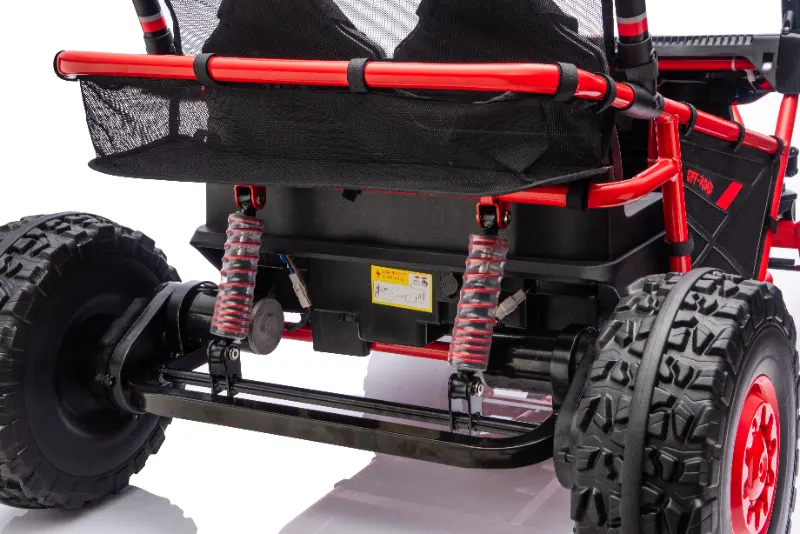


Rubber and Air-Filled Tires: Better Cushioning and Grip
Rubber is another common wheel material, especially for vehicles designed for rough ground or performance.
You'll also see the term “pneumatic tire” — an air-filled tire. The air inside helps absorb shocks and bumps [4]. A solid rubber tire has no air chamber; it keeps some of rubber's flexibility but needs no inflation [4][10].
Key characteristics of rubber: it is elastic and grippy; pneumatic tires use compressed air to soak up impacts, while solid rubber gives rubber-like compliance without air. It delivers high traction and good shock absorption, but is heavier and costs more.
Why choose rubber?
Rubber and air-filled tires offer:
- Better cushioning on uneven ground
- Strong grip on loose or rough surfaces
- A smoother journey
- Good support for vehicles built for higher speeds
Pneumatic tires cushion especially well on uneven terrain, while solid rubber needs no air and lowers puncture risk [4][10].
What are the downsides?
- Air-filled tires can be punctured.
- Air-filled tires need pressure checks.
- Rubber wheels can be heavier.
- Rubber wheels can cost more than basic plastic wheels.
Rubber and air-filled tires generally show up on performance-oriented models like motos and karts. If a vehicle is built for rougher ground or bigger kids, the extra grip and cushioning can matter more than basic hard-plastic wheels.
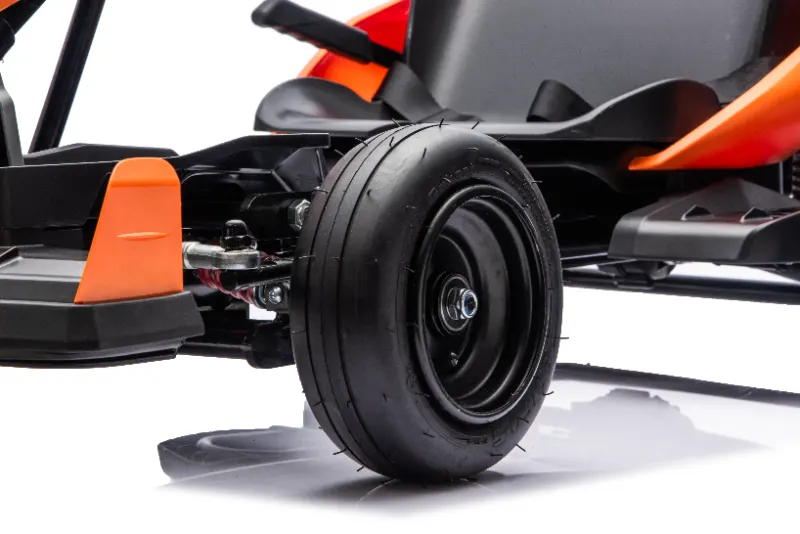
TPE and Mixed Wheels: Other Options You May See
Not every ride-on uses only PP, EVA, or rubber.
Thermoplastic elastomer (TPE) blends rubber's flexibility with plastic's processability. TPE comes in different hardness grades, so its performance varies by formula [11][12].
At First Ride On, we use TPE on one model — the 24V Dodge two-seater. We also use a mixed-wheel design on a couple of models, where different parts of the wheel use different materials:
- McLaren 24V 10Ah — softer PU tread up front over a rigid PA hub at the rear
- 12V drift kart — PP front with a glowing PU rear


For example, a softer tread gives more grip while a harder hub gives structural support. These designs may not be the first thing parents notice while shopping, but they show why checking the actual product specs beats judging a ride-on by its looks alone.
How Do Ride-On Wheels Perform on Different Surfaces?
The best wheel material depends on where your child rides.
- Pavement and driveways: PP plastic is the practical pick. It rolls easily, needs almost no maintenance, and is durable enough for daily driveway and sidewalk use. EVA usually feels softer and quieter, while rubber adds cushioning but more weight and rolling resistance [9][10].
- Grass: if the route is mostly grass, EVA and rubber are usually better. Grass resists more than smooth pavement, and damp grass makes hard-plastic grip harder to keep.
- Dirt: EVA and rubber give a more comfortable dirt ride; the softer material absorbs some of the jolts hard plastic would pass straight to the vehicle.
- Gravel and uneven ground: rubber and air-filled tires are especially useful for cushioning. EVA also works for light off-road, while hard plastic passes more shake and impact from the ground [10].
Do the tires on ride-on toys affect speed?
The wheel material usually doesn't set a ride-on's top speed. Battery voltage and motor power matter more. Tire material changes how speed feels through grip, rolling resistance, and cushioning. That's an important distinction: softer tires don't make a ride faster — they just make it feel steadier or more comfortable on some surfaces.
What Kind of Wheels Does First Ride On's Cars Use?
First Ride On uses different wheel materials across its lineup based on vehicle type and intended use. Our current products mainly use these tires:
- PP plastic wheels
- Rubber or air-filled tires
- EVA foam wheels
- TPE wheels
- Mixed-wheel designs
PP makes up most of the lineup, because many of our trucks, UTVs, and push cars are built for everyday riding on relatively flat ground.
| Model | Voltage | Speed | Tire | Age |
|---|---|---|---|---|
| 12V RAM 1500 RHO Fire & Police Truck | 12V | 1.3–2.6 MPH | PP plastic | 3+ |
| 12V Ford Bronco Raptor | 12V | 1.2–2.5 MPH | PP plastic | 3+ |
| 12V Porsche 718 | 12V | 1.9–3.7 MPH | PP plastic | 3+ |
| 12V RAM 1500 RHO Ride-On Truck | 12V | 1.3–2.6 MPH | PP plastic | 3+ |
| 12V Mercedes-AMG F1 W16 Racer | 12V | 2.1–3.4 MPH | PP plastic | 3+ |
| 12V Ford F-150 Raptor | 12V | 1.3–2.6 MPH | PP plastic | 3+ |
| 12V JCB 3-in-1 Excavator | 12V | 1.6–2.8 MPH | PP plastic | 3+ |
| 24V JCB 3CX Excavator | 24V | 1.25–5.0 MPH | PP plastic | 3+ |
| 24V Ford F-150 Raptor 2-Seater Truck | 24V | 2.1–5.0 MPH | PP plastic | 3+ |
| 24V Ram 1500 RHO 2-Seater Truck | 24V | 1.25–4.3 MPH | PP plastic | 3+ |
| 24V Dodge Charger R/T 2-Seater Muscle Car | 24V | 2.0–5.0 MPH | TPE | 3+ |
| 24V McLaren Drift Go-Kart | 24V | 7.5 MPH | TPR / PA nylon (mixed) | 6+ |
| 24V Ford Bronco Raptor 2-Seater Truck | 24V | 2.1–4.4 MPH | PP plastic | 3+ |
| 24V Chevrolet Silverado 2-Seater Truck | 24V | 2.1–3.85 MPH | PP plastic | 3+ |
| 24V Ford Bronco Base 2-Seater Truck | 24V | 2.05–4.35 MPH | PP plastic | 3+ |
| 24V Ram 1500 RHO 2-Seater Fire Truck | 24V | 1.25–3.7 MPH | PP plastic | 3+ |
| 24V Ram 1500 RHO 2-Seater Police Truck | 24V | 1.25–3.7 MPH | PP plastic | 3+ |
| 36V 2-Seater Off-Road UTV | 36V | 5–8 MPH | EVA foam | 6+ |
| 36V McLaren Drift Go-Kart | 36V | 5.6–8.7 MPH | TPR / PA nylon (mixed) | 6+ |
| 48V McLaren High-Performance Drift Go-Kart | 48V | 5–15 MPH | Rubber (high-grip drift) | 8+ |
| Ford Bronco Raptor 3-in-1 Push Car with Canopy | — | — | PP plastic | 0–3 |
| Ford Bronco Raptor Push Car | — | — | PP plastic | 0–3 |
| Ford Bronco Raptor 2-in-1 Push Car with Parent Handle | — | — | PP plastic | 0–3 |
EVA and rubber show up on specific models where cushioning, grip, or a different ride feel matter more. Generally, just choose by the car's voltage and age range — the right tire comes matched to the model.
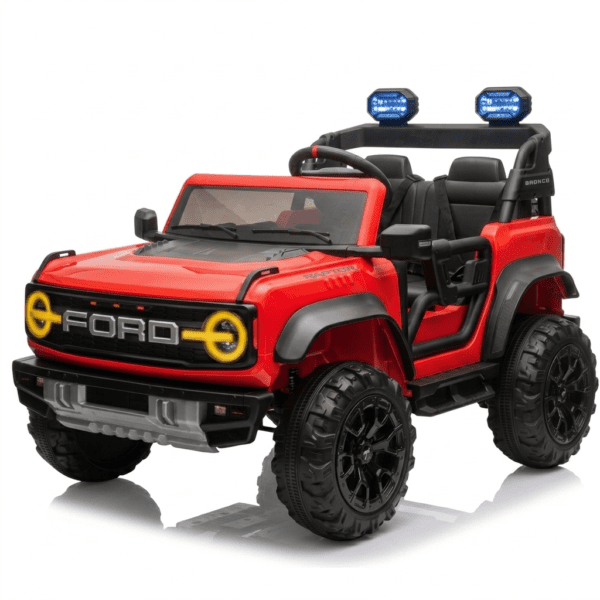


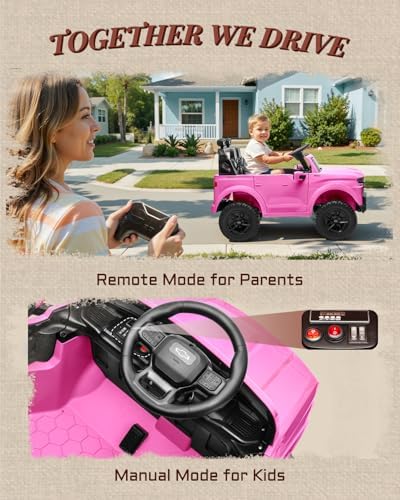
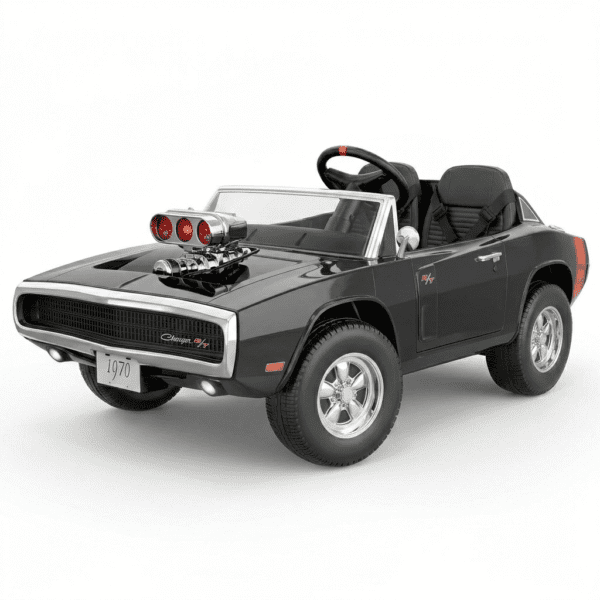

First Ride On 1970 Dodge Charger R/T 24V 2-Seater Electric Muscle Car
How to Tell What Tires a Ride-On Has Before You Buy
If tire type matters to you, check the product spec before ordering. A few simple things to note:
- Check the tire material. Look for terms like PP, EVA, rubber, TPE, PU, or pneumatic.
- Think about where your child will ride. Driveway-only and grassy-backyard riding don't need the same wheel.
- Check the whole vehicle, not just the tires. Motor, battery, weight limit, age range, and design all shape the ride.
- Check the relevant safety info. In the U.S., ASTM F963 is the relevant toy-safety standard [5]; European products may reference EN 71 [16].
Does Ride On Cars Tire Type Affect Battery Life?
Yes — but not the way you might think. Every wheel creates rolling resistance. On flat ground, harder wheels usually have less rolling resistance than softer, heavier tires. Industrial caster studies show differences in rolling resistance among plastic, rubber, and other wheel materials [9][10].
In practice:
- Flat pavement suits almost any ride-on better than grass.
- Softer or heavier tires roll with more effort.
- Grass, dirt, and slopes usually ask more of the motor than flat asphalt.
- Battery voltage and motor power affect performance far more than the wheel material itself.
So if battery range matters, don't look at tires alone — consider battery, motor, terrain, vehicle weight, and riding conditions together.
Safety Notes
The right wheel material doesn't replace correct use. Always follow the manufacturer's age guidance, weight limits, operating instructions, and maintenance advice.
- Hard plastic can grip poorly on wet or slippery surfaces.
- Air-filled tires need the manufacturer's specified pressure.
- Rough terrain adds load to the vehicle.
- Always match the ride-on to your child's age and the stated weight limit.
- Check the toy-safety requirements that apply in the market where the product is sold.
Can Ride-On Wheels Be Upgraded or Replaced?
Check your product manual. Because our ride-ons need assembly after delivery, if a tire is damaged in use and it's within First Ride On's 6-month warranty, it can be replaced; for products past 6 months, contact our support team for the best advice. If you're considering swapping wheels on a specific First Ride On model, check the product info or contact our support team first.
FAQs about Ride-On Toys Wheels
Is EVA better than plastic for a ride-on?
PP suits flat ground and everyday low-maintenance riding — practical. EVA is quieter and gives better cushioning and grip on grass and dirt. Which to pick depends on where your child rides.
Which ride-on tire is best for grass?
EVA foam or rubber wheels are good on grass — they usually give better cushioning and grip than hard plastic. Damp or uneven grass is more challenging for hard plastic.
Are rubber tires better for ride-ons?
Rubber is a good choice when you need cushioning and grip, especially on uneven ground. But rubber wheels are usually heavier and pricier than plastic.
Do ride-on air-filled tires leak?
Yes. Air-filled tires can leak or be punctured, so they need more maintenance than solid plastic or foam tires.
Do tires change top speed?
Usually not. The motor and battery affect rated top speed more. Tire material mainly affects rolling resistance, grip, and ride comfort.
Do push cars need EVA or rubber tires?
Not necessarily. Push cars are designed differently because a parent provides the power. For younger kids, a push car's focus is usually a stable, easy-rolling experience rather than speed or off-road ability — so push cars usually use PP plastic.
Wrap-Up — What kind of Ride On Car Wheel Should You Choose?
The simplest way to think about it:
- Mostly sidewalks and driveways? PP plastic is a simple, durable, low-maintenance choice.
- Grass, dirt, and neighborhood paths? EVA gives a quieter, softer ride, while rubber adds extra cushioning and grip.
- Rough ground or performance riding? When grip and shock absorption are critical, rubber or air-filled tires may fit better.
Remember, the fanciest material isn't automatically the best. So look at the ground outside your door, pick the ride-on that fits your little driver, and roll out. Love at first ride!
References
[1] Wikipedia. “Polypropylene.”
[2] Wikipedia. “Ethylene-vinyl acetate.”
[3] Wikipedia. “Rubber.”
[4] Wikipedia. “Tire.”
[5] ASTM International. ASTM F963 — Standard Consumer Safety Specification for Toy Safety.
[6] EuroPlas. “What Is Ethylene Vinyl Acetate (EVA)? Characteristics and Applications.”
[7] SRP Co. “EVA Foam Material.”
[8] Damao Tech. “7 Key Advantages of EVA Foam for Industrial Manufacturing.”
[9] unracking (Spieth). “How to Choose the Right Wheels for Logistic Trolley Carts” (PP vs PU vs Rubber).
[10] AIMS Industrial. “Castor Wheel & Caster Guide” (pneumatic vs solid rubber, PP, TPR).
[11] DERSHENG. “How to Choose Caster Wheel Material” (TPR Shore A 60–75).
[12] Greatchip (htluggage). “Performance Differences and How to Choose the Right One” (TPE silent wheels).
[13] Matsumoto, S., et al. “Effect of the Porosity Distribution on Dry Sliding Friction and Wear of Cross-Linked EVA Foams.” Procedia Manufacturing / ScienceDirect, 2020.
[14] Hong, X.; Zheng, Y. “Sodium lignosulfonate-assisted reduction of graphene oxide for enhancing thermal stability and wear resistance of EVA foams.” Polymer, 2026, 129540.
[15] Wang, Y.; Du, W.; Yang, Y.; Huang, J. “Study on the Wear-Resistance and Slip Resistance of EVA Foamed Sole Materials.” China Plastics Industry, ISSN 1005-5770.
[16] Wikipedia. “EN 71.”