Blog
48V vs 24V Ride-On Cars: What’s the Difference and How Do You Choose?
48V is high voltage for kids' ride-ons, and 24V is the most common voltage.
On this page
Key TakeawaysWhat Do 24V and 48V Mean in Ride-On Toys?What's the Difference Between 24V and 48V Ride-Ons?A Verified 48V High-Performance Ride-On: FRO's McLaren Go-KartHow to Check the Specs Before You BuyShould You Choose a 24V or 48V Ride-On for Your Kids?FAQs About Choosing 24V or 48V Ride-OnsMost parents assume a 48V ride-on is faster, stronger and better for older kids than a 24V one. Many also assume it runs longer. Often the first part is true, but not always, and the run-time part usually isn't.
What a car actually does depends on its battery setup, its motors and the way the whole vehicle is designed, not on the voltage number alone.
If you're comparing 24V vs 48V ride-on toys, this guide covers what really separates them, how to choose for your child, and what to look for if you decide on a 48V car.
Key Takeaways
- The main difference is positioning and setup. 24V and 48V ride-ons differ in how the cars are designed and equipped, not in the voltage number itself.
- 48V is high voltage for kids' ride-ons. It usually appears on larger, performance-focused models, and many suit teens or kids with driving experience. These cars typically offer a higher top speed and weight limit, and a better driving experience.
- 24V is the most common voltage. It covers a wide range of models and ages, and the features vary a lot.
- Match the car to the need. If you want a fast, high-performance car, look at 48V. If it's for everyday play, 24V comes in plenty of speeds and weight limits.
- Voltage doesn’t tell you how long a ride-on will run, how long it takes to charge, how long the battery will last, or how safe the vehicle is. Check the product specifications for detailed information.
What Do 24V and 48V Mean in Ride-On Toys?
The “V” stands for volts, the voltage of the battery system. Think of it as a spec about the battery, not a score for the whole car. On its own, voltage can't tell you how fast a ride-on goes, how much weight it carries or which age it suits.
Still, parents use it as a first filter, and for good reason. Designers tend to pair higher voltage with bigger, faster models, so a habit formed: search “24V” for everyday play, and “48V” when you want performance.
What's the Difference Between 24V and 48V Ride-Ons?
In the listings we checked, the real differences come down to the type of car and how it's equipped.
| Typical 24V ride-ons | 48V ride-ons | |
| Vehicle types | Wide range: realistic cars, two-seat UTVs, drift go-karts | Fewer models, performance-focused: go-karts, UTVs, off-road buggies |
| Typical age | Mostly 3–8; go-karts often 6+ or 8–12 | Mostly 13+ or 14+; some models for 6–12 or 3–8 |
| Top speed | UTVs about 3–5 mph; go-karts about 6.5–8 mph | About 5–23 mph; performance models often 10–20 mph |
| Weight limit | About 66–133 lb; a few larger models 176 lb | About 110–176 lb; four-seaters up to 330 lb |
| Run time | About 40–90 minutes, no clear link to voltage | About 40–90 minutes, no clear link to voltage |
| Parental controls | Depends on the model, not the voltage | Depends on the model, not the voltage |
| Design focus | Two seats, seat belts, lights, music, remote control | Bigger motors, speed modes, frame, tires, suspension, brakes |
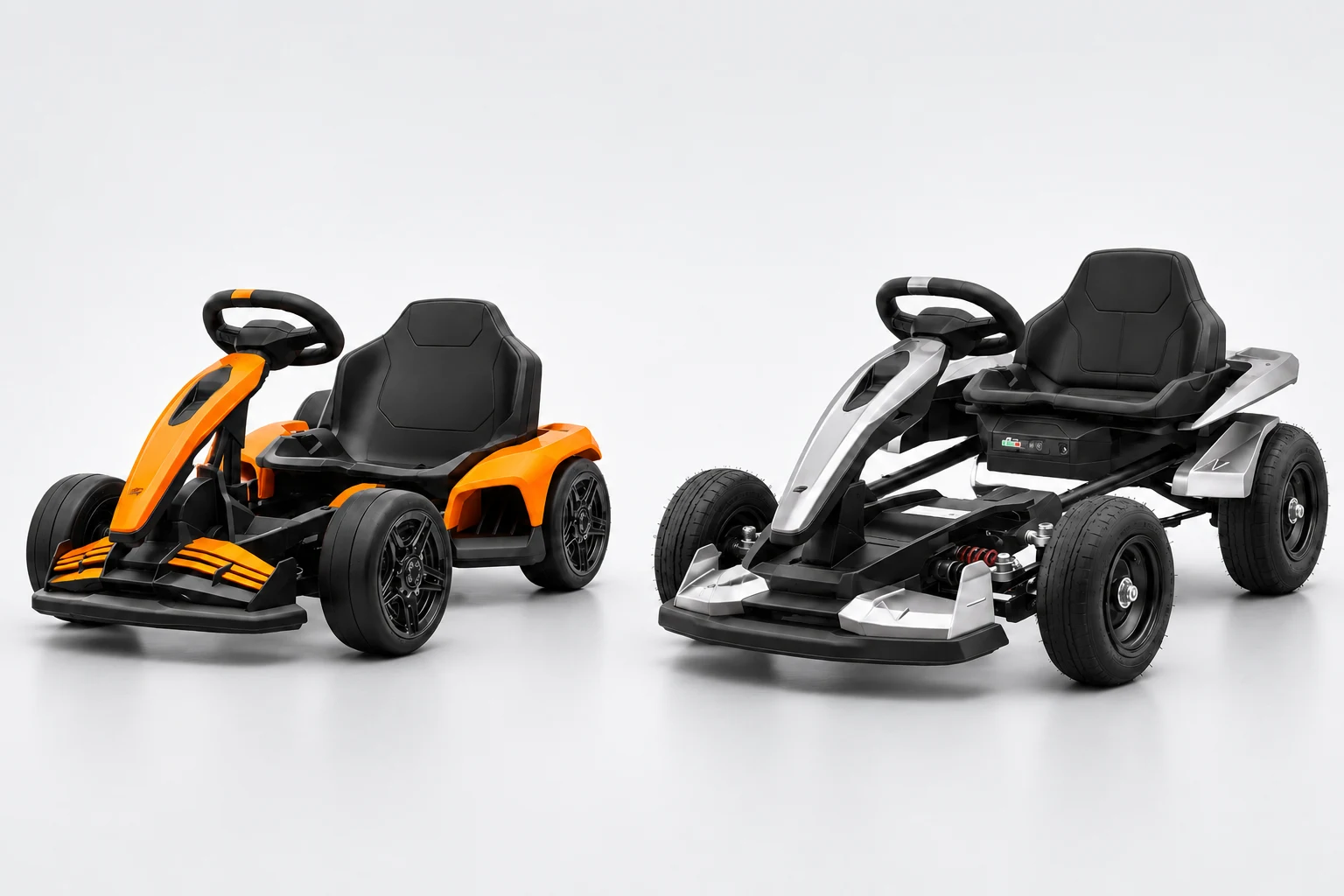
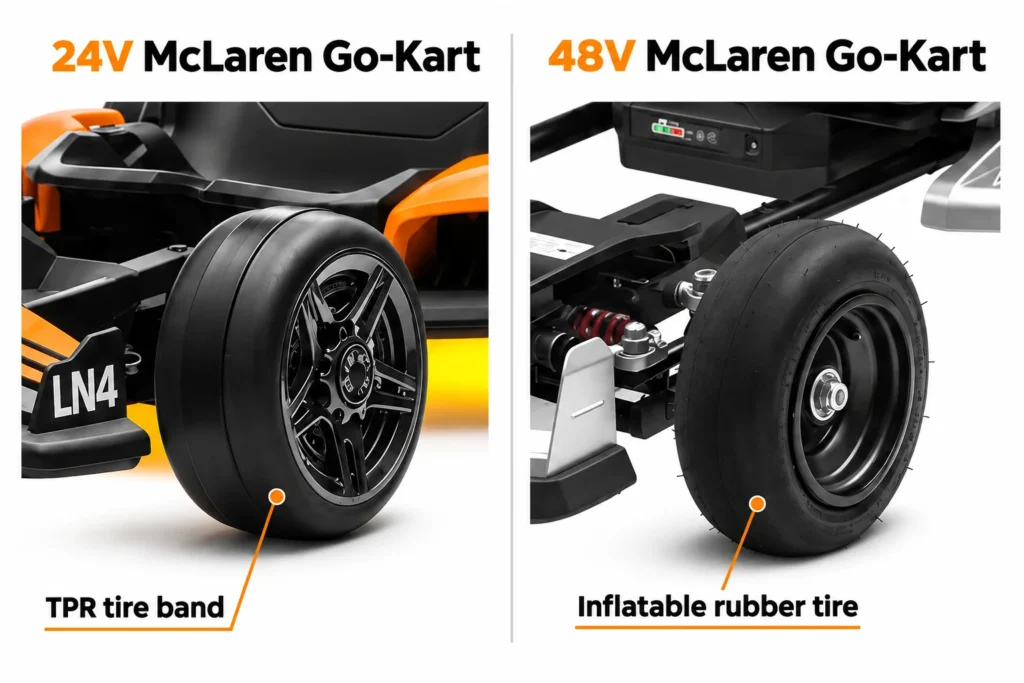
The McLaren go-karts show how a higher-voltage model can come with different supporting parts. The 24V kart uses plastic wheels with TPR front tire bands and nylon rear tire bands designed for drifting. The 48V kart moves to inflatable rubber tires and four-wheel suspension. Those choices suit the 48V model’s faster, larger design; they are features of these two karts, rather than upgrades guaranteed by a higher voltage.
Three things stand out:
- 48V cars are built as a package. They often come with a higher weight limit and top speed, plus better tires and motors, and they lean toward older kids. That's a product-design choice, not something voltage does by itself.
- 24V covers the widest ground. As the most common voltage, it spans two-seat cars, ATVs, go-karts and motorcycles, for ages from 3 up to 13+, so the features and price vary a lot.
- Voltage is only a rough filter. In ordinary kids' ride-ons, a maker can use 48V to move a bigger, heavier body, or keep the speed down at the same level as a 24V car. The spec sheet tells you which.
Run time deserves its own mention, because it's a common myth. Listings for 24V, 36V and 48V cars mostly claim about 40–90 minutes, and the figure shifts with rider weight, speed and terrain. A higher voltage doesn't buy you longer play.
Tech note: how a “48V” label can be built (and what “2x24V vs 48V ride on” means)
A ride-on labeled 48V may use one of these battery setups.
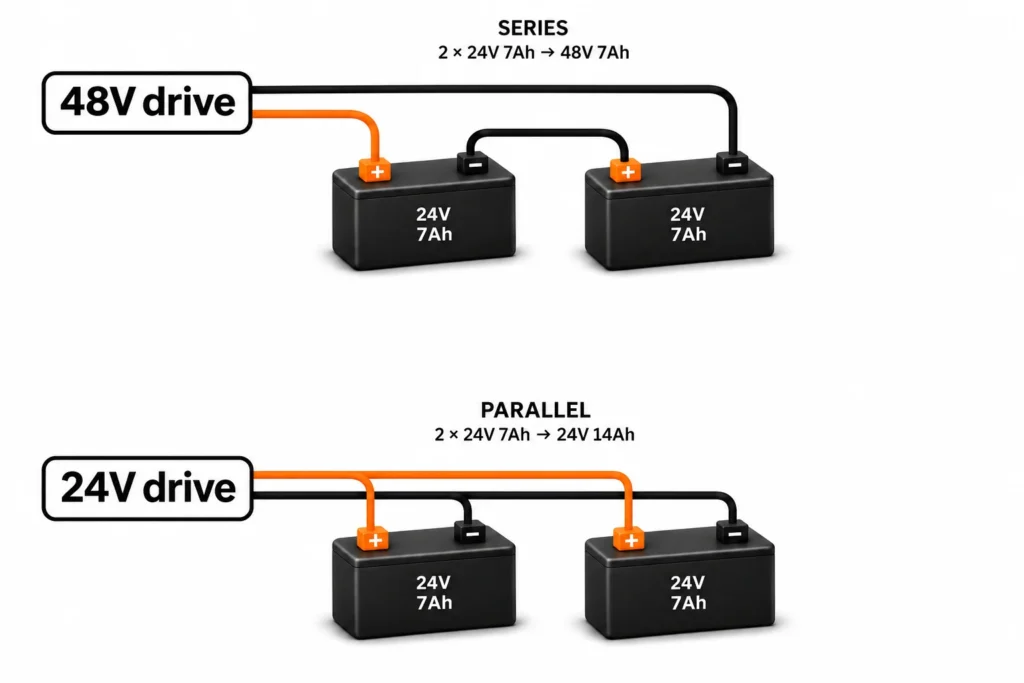
- One 48V battery, or two 24V batteries or four 12V batteries wired in series. This powers a 48V system, so the car has more power than a typical 24V car. It doesn't add run time.
- Two 24V batteries wired in parallel. The system is still 24V, but the battery capacity increases, so the car has a longer run time than a typical 24V car. It doesn't automatically get faster.
A Verified 48V High-Performance Ride-On: FRO's McLaren Go-Kart
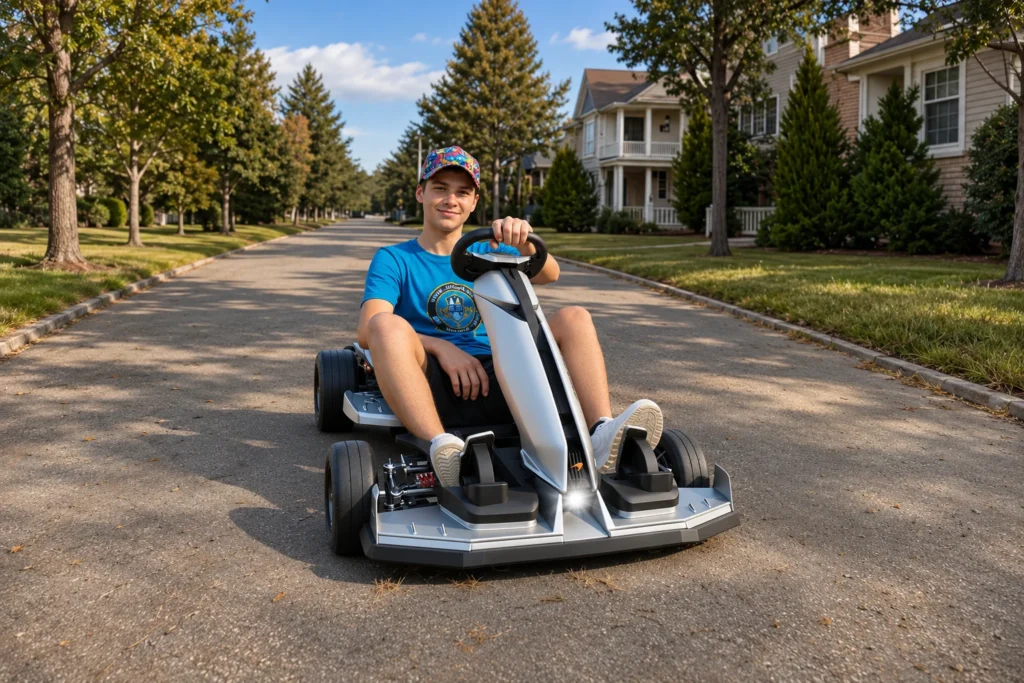
Some ride-ons are advertised as “48V” because they contain two 24V batteries, without making clear what voltage drives the vehicle. The First Ride On McLaren 48V Drift Go-Kart is built around a 48V drive system and a 48V 7.6Ah lithium battery. Its performance comes from the complete design: the battery, motor, speed settings, and driving controls work together to create a kart intended for older riders.
| Feature | McLaren 48V Drift Go-Kart |
| Battery | 48V 7.6Ah lithium battery |
| Motor | 750W rated power; 1,000W peak |
| Forward speeds | 5.0, 9.9, and 14.9 mph |
| Recommended age | 14+ |
| Maximum rider weight | 176 lb |
| Fit | Four-position adjustable seat; rider height up to 6 ft 3 in |
| Tires and suspension | Inflatable rubber tires and four-wheel suspension |
The lithium battery is another meaningful part of this setup. Lithium batteries can store substantial energy without the weight of an equivalent lead-acid battery, which helps make them useful in performance-focused vehicles.
How to Check the Specs Before You Buy
A 48V sticker doesn't tell you what the car will do. Before you buy, check the spec sheet in three steps.
- Check the speed and speed modes. Look for the top speed and how many speed settings there are. Speed tells you far more about how a ride-on will feel than voltage does.
- Check the weight limit, height and age. Match them to your child's weight, height and driving experience.
- Check the battery and motor together. Voltage and motor power (in watts) work as a pair. A 48V car with a high-power motor is built for performance. A 48V car that tops out near 5 mph is aimed at a different kind of rider.
If a listing is vague on any of these points, ask the seller for the full spec sheet. And if you see “2×24V” on a label, the tech note above explains why it can mean two different things.
Should You Choose a 24V or 48V Ride-On for Your Kids?
- For everyday play, a lower speed or a realistic driving feel: shop the wide 24V range and pick the speed, weight limit and seat count that fit.
- If your child meets the age, height and driving requirements of a specific 48V model, and you want the speed, space, weight capacity or driving feel it offers: that's when 48V has a clear reason to be on your list.
- If you're looking at go-karts, you can also glance at 36V.
- Once you lean toward 48V: check the specs for what you care about most, whether that's speed, weight limit or play time. Different 48V cars lean different ways, so don't assume one is strong at everything.
FAQs About Choosing 24V or 48V Ride-Ons
Is 48V Twice as Fast as 24V?
No. Top speed comes from the vehicle's design and speed limiter, not from voltage alone. The 48V UTV for ages 3–8 mentioned earlier (Brand A) lists a top speed of about 5 mph (8 km/h). That's close to the 3.9–5.1 mph of the 24V UTVs we checked, and slower than most 24V go-karts, which run roughly 6.5–8 mph.
Will Two 24V Batteries Last Twice as Long as One?
Not necessarily. First look at how the batteries are connected. Two in parallel keep the car at 24V and add capacity, which helps run time. Two in series make a 48V system, which adds power rather than run time. Even with extra capacity, play time rarely doubles, because faster and heavier cars use up energy faster. For example, a UTV with two 24V batteries (Brand A) lists about 80 minutes, while similar single-battery 24V UTVs list roughly 45–70 minutes.
Does “2×24V” Always Mean a 48V Ride-On?
No. Two 24V batteries wired in series make a 48V system. Wired in parallel, the car is still 24V, just with more capacity. The spec sheet usually gives the system voltage, so check whether it says 48V or 24V. If it only says “2×24V,” ask the seller how the batteries are connected.
Can I Upgrade a 24V Ride-On to 48V by Adding a Battery?
Don't treat adding a battery as an ordinary upgrade. The controller, motors, wiring, charger and protection circuits are all matched to the original voltage, so changing it can damage the car, create safety risks and affect the warranty. Stick to the configuration the manufacturer specifies.
Is a 48V Ride-On Appropriate for My Child?
Judge it by the specific model: its minimum age, height and weight limits, speed modes, and whether your child can handle it. Voltage alone can't answer that. Most of the 48V cars we found are rated 13+ or 14+. Start on the lowest speed setting, use a helmet and protective gear, and supervise rides.
The next adventure
starts with the right ride.
Put your shortlist into motion. Explore ride-ons and compare the details that matter to your family.
Find Their Ride