
Blog
How Does Voltage Affect a Kids’ Ride-On Car?

Why does one electric ride-on car climb across the lawn while another slows down? And why can a car with a larger voltage number sometimes have a shorter battery runtime? The answer is that voltage is only one part of an entire electrical and mechanical system.
This guide explains what voltage means in a kids’ ride-on car, how it relates to speed and power, and which specifications actually matter. Whether you are comparing 6V, 12V, 24V, 36V, or another system, the same basic principles apply.
Quick answer: Voltage describes electrical potential. It helps determine what a motor system can do, but the actual driving result depends on the motor, current, controller, gearing, wheels, battery capacity, rider load, and terrain. Higher voltage does not automatically mean a faster or safer toy—or longer runtime.
If you are simply deciding between the two most common shopping options, start with our 12V vs 24V Ride-On Cars: Which Is Right for Your Child? This article goes deeper into the reasons behind the differences.
What Is Voltage in an Electric Ride-On Car?
Voltage is the electrical potential difference that pushes charge through a circuit. It is measured in volts, written as V. You can picture it loosely as pressure in a water system: a higher pressure can help a system deliver more energy, but it does not tell you how much water will actually flow through the pipes.
In a ride-on car, the battery supplies electricity, the controller regulates how it reaches the motor, the motor turns, and gears transmit that rotation to the wheels. The nominal battery voltage—such as 6V, 12V, 24V, or 36V—describes one basic operating characteristic of this system.
A voltage rating is not a speed rating or an age label. Two vehicles can operate at the same voltage and still have different motors, wheel sizes, gear ratios, weight limits, or speed settings.
Why Do Ride-On Cars Come in Different Voltages?
Manufacturers design ride-ons for different combinations of size, expected load, speed, terrain, cost, and battery configuration. One way to support those design goals is to select a voltage system appropriate for the motors and electronics.
A compact beginner vehicle may use a lower-voltage system, while a larger model intended to carry more weight or deliver more power may use a higher-voltage system. This explains why 6V, 12V, 24V, and sometimes higher numbers appear on product pages.
There is no universal rule that a particular voltage is required for a particular age. A 24V system can be deliberately speed-limited, while a fast 12V vehicle can still require mature driving skills. Follow the manufacturer's minimum age and intended-use instructions.
How Voltage, Current, and Watts Work Together?
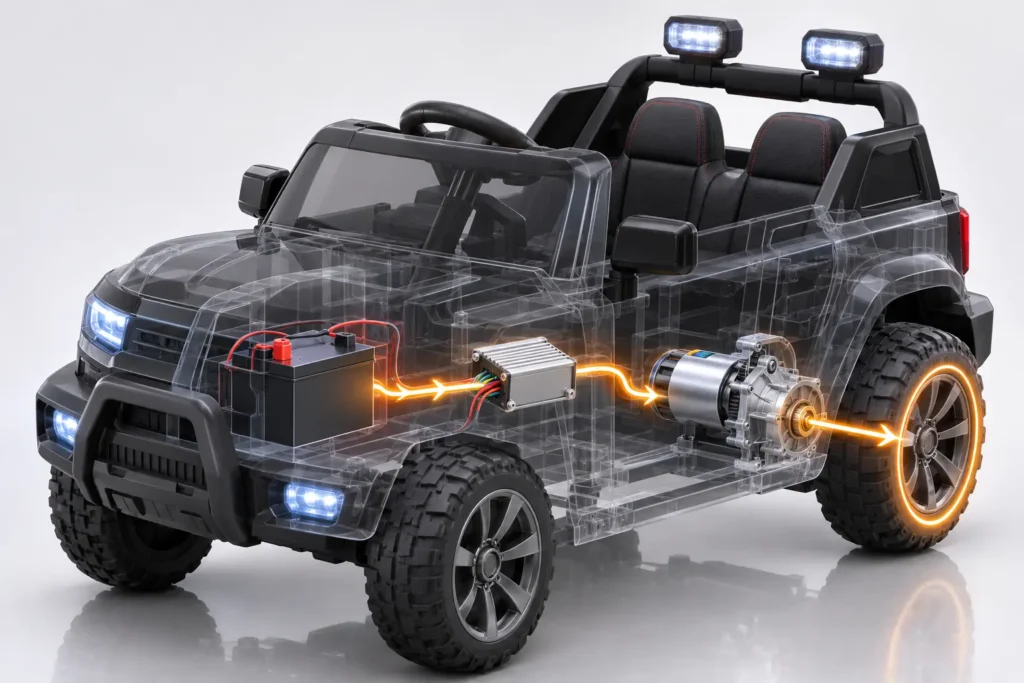
To understand performance, start with three electrical measurements: voltage (V), current (A), and power (W).
Voltage (V): Electrical Potential
Voltage is the potential difference available to move electrical charge. A higher voltage can help a properly designed system transfer more power, but only if the motor, controller, wiring, and battery can handle the operating conditions.
Current (A): The Flow of Electrical Charge
Current, measured in amperes or amps, is how much electrical charge flows per second. How much current the ride-on draws changes with driving conditions. Accelerating, climbing an approved incline, or moving across resistant ground can require more current than cruising on level pavement.
Power (W): Energy Delivered Per Second
Electrical input power is commonly approximated by Power (W) = Voltage (V) × Current (A). For example, if one system draws 10A at 12V, its input power is 120W. At 24V and the same current, input power is 240W.
That example demonstrates the relationship; it does not mean doubling the voltage of an existing 12V toy is a safe way to double its performance. A different supply can change current and stress components, and electrical input power is not the same as useful mechanical power at the wheels.
The motor and drivetrain lose some energy as heat, noise, and friction. Controllers can also limit speed or current. This is why the printed voltage cannot predict a real vehicle's power by itself.
How Does Voltage Affect Speed?
For many DC motor designs, changing the voltage can change the motor's achievable rotational speed under a given set of conditions. But the wheel speed that a child experiences depends on more than motor speed.
The gears reduce the motor's rotation to a useful wheel speed. Wheel diameter changes the distance traveled per revolution. The controller can cap speed electronically, and the rider's weight or terrain may keep the vehicle below its advertised maximum.
That means a higher-voltage car is often designed for higher performance, but a carefully limited 24V model may travel more slowly than a 12V model with different gearing and controls.
A useful shopper's question is not just “How many volts?” but “What is the lowest and highest driving speed, in mph, and can the faster mode be locked out?”
How Does Voltage Affect Torque, Acceleration, and Hill Climbing?
Torque is a turning force. At the motor shaft, it helps create rotation; through the gearbox, that turning effort reaches the wheels. The available wheel torque is one of the things that helps a car start moving, carry a rider, or overcome resistance.
For a typical DC motor, torque is strongly related to motor current, while speed is influenced by voltage and motor design. Gear ratios can trade wheel speed for wheel torque: gearing designed for pulling or climbing may sacrifice top speed to improve the force at the wheels.
This is why more volts does not necessarily mean more wheel torque. A lower-voltage ride-on with suitable motors and gearing may handle a certain load better than a higher-voltage toy optimized for speed.
Traction is another limit. If the wheels slip on grass or gravel, additional motor power may simply spin them. Four-wheel drive may help distribute traction, but total motor output, tires, and surface conditions still matter.
Never treat a stronger drivetrain as permission to drive on steep hills. Follow the model's stated slope and terrain limits.
Does Higher Voltage Mean a Longer Battery Runtime?
No. Battery runtime depends on stored energy and how quickly the vehicle uses it, not voltage alone. To compare batteries fairly, you need to understand amp-hours and watt-hours.
What Does Ah Mean on a Ride-On Battery?
Amp-hours (Ah) describe charge capacity. A battery labeled 12V 10Ah has a nominal voltage of 12V and a rated capacity of 10Ah. The Ah number alone does not tell you how much energy a battery stores unless you also know the voltage.
Why Watt-Hours (Wh) Matter More for Comparing Batteries
Watt-hours estimate stored energy: Wh = nominal V × rated Ah. Here is a simple example:
| Example battery | Nominal energy | What it means |
| 6V 10Ah | 60Wh | Smaller nominal energy than the two examples below |
| 12V 10Ah | 120Wh | Same nominal energy as a 24V 5Ah pack |
| 24V 5Ah | 120Wh | Higher voltage but not more nominal energy |
| 24V 7Ah | 168Wh | More nominal energy, but not automatically more driving time |
These are illustrative calculations, not promises of usable energy or runtime. Real batteries vary with chemistry, temperature, discharge rate, age, and the manufacturer's capacity-rating conditions.
A car with a bigger nominal energy store may still run for less time if it has more demanding motors, a heavier load, or challenging terrain.
A Simple Runtime Example
Suppose two batteries each store a nominal 120Wh. If one vehicle averages 60W of electrical consumption, its idealized calculation is 120 ÷ 60 = 2 hours. If another averages 120W, the idealized calculation is 120 ÷ 120 = 1 hour.
These are teaching examples, not reliable runtime forecasts. In real riding, power draw rises and falls, and not all nominal battery energy is usable. Manufacturer testing under stated conditions is much more useful than calculating from battery labels alone.
How Do Motor Ratings and Drive Systems Change Performance?
A product page might say “2 × 35W motors” or “4 × 100W motors.” This generally describes how many motors are installed and their advertised ratings. It does not prove that the vehicle continuously consumes or delivers the sum of those numbers at all times.
A 2WD ride-on powers two wheels. A 4WD ride-on powers four. Four-wheel drive can improve traction in some conditions, but it is not a substitute for suitable tires, gearing, and adequate motor capability.
Also check rated rider weight, wheel material, gear ratios when published, and approved surfaces. A product may have plenty of electrical power but perform poorly on wet grass because its tires cannot grip.
What Happens When Two Batteries Are Connected in Series or Parallel?
Some higher-voltage ride-ons use a single battery pack. Others use multiple compatible batteries wired together by the manufacturer. Two common electrical arrangements are series and parallel.
Series connection: Nominal voltages add. Two matched 12V 7Ah batteries in series form a nominal 24V 7Ah system. Their Ah capacities do not simply add in this arrangement.
Parallel connection: Nominal voltage stays the same while the combined rated Ah capacity can increase. Two appropriately matched 12V 7Ah batteries in parallel form a nominal 12V 14Ah system.
These are explanations of battery concepts, not instructions to rewire a child's toy. Safe battery configurations require compatibility checks, suitable protective devices, and a charging system designed for the complete pack. Incorrect modifications can damage the vehicle or create overheating and fire risks.
Can You Upgrade a 6V or 12V Ride-On to a Higher Voltage?
A higher-voltage battery is not a drop-in speed upgrade. Motors, speed controllers, switches, lights, wiring, and charging systems are designed for particular electrical limits. Exceeding them can cause overheating, sudden performance changes, component damage, or fire hazards.
Power-tool battery adapters deserve the same caution. Even if a plug fits, the voltage range, current demands, low-voltage protection, charger, and battery chemistry may differ from the toy's original system.
For family use, the safer choice is to maintain the original approved electrical configuration, replace batteries only with manufacturer-compatible parts, and choose a purpose-built vehicle when greater capability is needed. Do not bypass an age rating through a modification.
How to Read a Ride-On Car Specification Without Being an Engineer
Imagine a product lists 24V 7Ah battery · 4 × 100W motors · 4WD · 2–5 mph (3.2–8 km/h). Read it in this order:
24V: The nominal system voltage—not a promise about speed.
7Ah: Battery charge capacity. Combined with voltage, it gives about 168Wh of nominal energy.
4 × 100W: Four motors with an advertised 100W rating each; ask whether the manufacturer clarifies rated or peak output.
4WD: Four powered wheels; traction still depends on tires and ground conditions.
2–5 mph (3.2–8 km/h): The manufacturer's stated speed range, which matters directly to your child's experience.
Then check things that aren't in that line: recommended age, rider-weight limit, seat dimensions, braking, remote controls, terrain restrictions, warranty, and replacement parts.
The Bottom Line
Voltage influences the electrical conditions under which a ride-on motor system works, but it never tells the whole performance story. Speed, pulling force, runtime, and terrain capability result from the complete design: battery, motor, controller, gearing, wheels, and load.