
Blog
Is a 12V or 24V Ride-On Better for Your Child? What to Know Before You Buy

12V vs 24V Ride-On Cars: Which Is Right for Your Child?
Voltage is often one of the first specs parents look at when choosing an electric ride-on car, with 12V and 24V being the most common options. Compared to higher-voltage models, these tend to be better suited for younger kids, making them popular choices for a child's first ride-on car.
Before making a decision, it's worth understanding how 12V and 24V models differ in performance, driving experience, and age suitability.
Key Takeaways
24V ride-ons generally offer greater power potential than 12V models, making them better suited to larger vehicles, heavier loads, and more demanding riding conditions.
- Choose 12V ride-ons for children around ages 3–5 who are new to ride-ons and will mainly drive on flat surfaces or short grass. These models are often more affordable and easier to manage for beginners.
- Choose 24V ride-ons for older or more experienced children, typically around ages 5 and up, who need greater driving performance for larger outdoor spaces or more demanding terrain.
- Look beyond voltage: Battery capacity (Ah), motor wattage, 2WD vs. 4WD, tire traction, and speed settings all affect real-world performance. Always compare the full specifications and manufacturer's age and weight limits before buying.
12V vs 24V at a Glance
| Feature | 12V ride-on | 24V ride-on |
|---|---|---|
| Typical age | About 3 to 5 | About 5 to 10 |
| Typical top speed | About 2 to 5 mph (3 to 8 km/h) | About 4 to 6 mph (6 to 10 km/h), some faster |
| Best terrain | Pavement, driveways, short dry grass | Thick grass, gentle slopes, gravel |
| Power and torque | Moderate | Higher |
| Weight capacity | Often about 55 to 90 lb (25 to 40 kg) | Often about 90 to 130+ lb (40 to 60+ kg) |
| Seats | Usually 1 | 1 or 2 |
| Runtime per charge | 1 to 2 hours | 1 to 2 hours |
| Full charge time | 8 to 12 hours | 8 to 12 hours |
| Typical price | $150 to $300 | $300 to $600+ |
- Runtime and charge time look the same in both columns because voltage doesn't set them. Runtime depends on battery capacity (Ah) and motor draw, and charge time on capacity and charger output.
- Ride-ons with the same voltage can have different speeds and age ranges. Voltage, motor setup, and speed controls affect how fast a car goes, while its size, design, seat belt, and other safety features also determine whether it's suitable for a child.
What Does 12V vs 24V Mean in a Ride-On Car?
The “V” stands for volts, a measurement of electrical potential. A higher-voltage system gives manufacturers more room to build a powerful electric drivetrain when paired with the right motors and controller.
For a ride-on car, this can affect several things your child will notice while driving:
- How fast the car can go.
- How quickly it picks up speed when your child presses the pedal.
- How well it handles inclines without slowing down.
- How easily it moves across grass without getting bogged down.
These aren't determined by voltage alone. How voltage affects a ride-on's performance also depends on motor design, the controller, gearing, and tires, while battery capacity affects how long it runs between charges.
A Real-World Example of 12V vs. 24V Ride-Ons
The difference between 12V and 24V becomes easier to understand when you compare two versions of the same ride-on model. Take the First Ride On Ford F-150 Raptor, available in both 12V and 24V versions.
Although they share the same model design, their specifications reveal some important differences in driving performance.
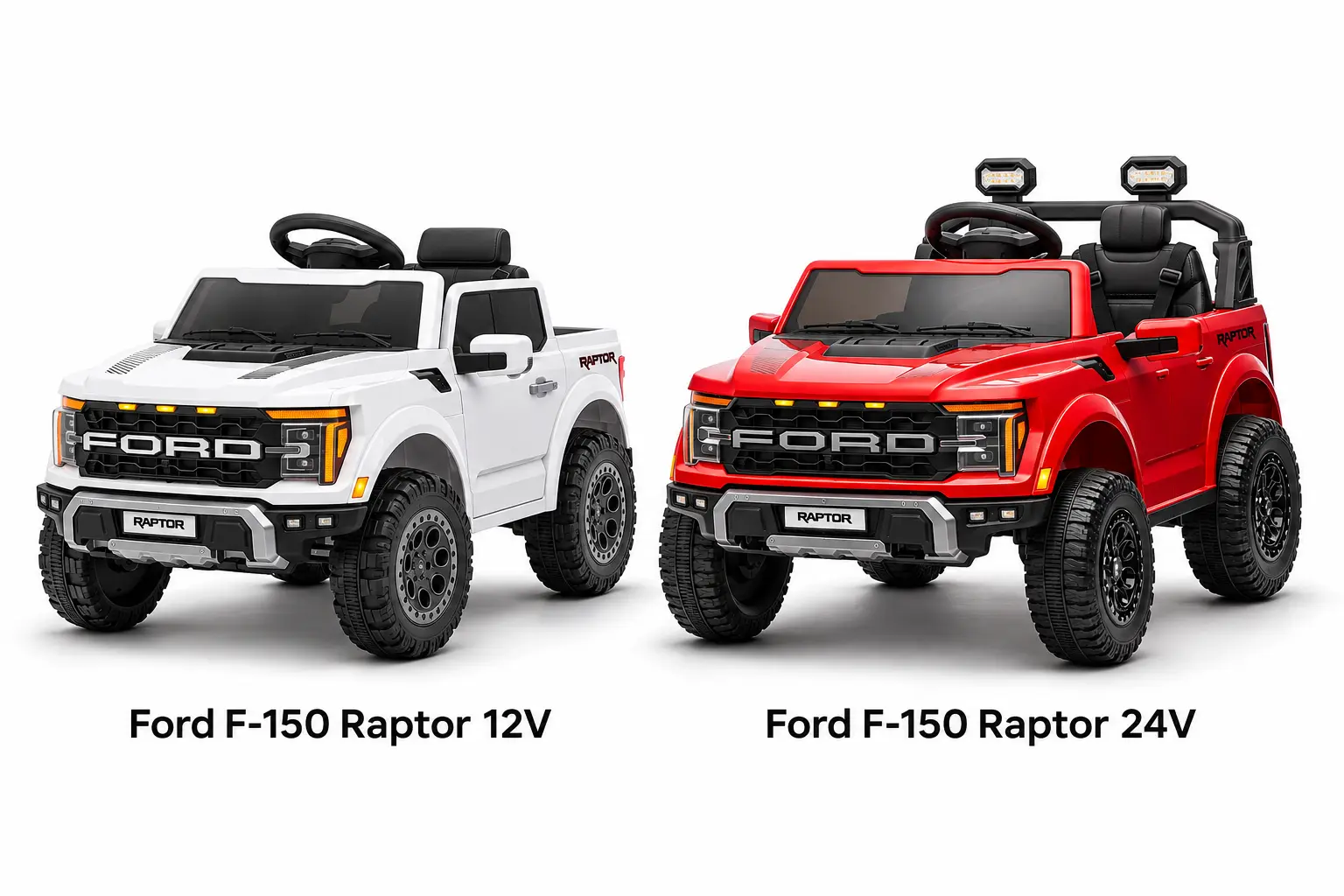
| Specification | Ford F-150 Raptor 12V | Ford F-150 Raptor 24V |
|---|---|---|
| Motors | 2 × 25W | 2 × 90W |
| Top speed | 2.6 mph | 4.3 mph |
| Maximum weight capacity | 66 lbs | 132 lbs |
| Seating | 1 rider | 2 riders |
As the comparison shows, the 24V version comes with more powerful motors, a higher top speed, twice the weight capacity, and room for an additional rider.
Similar differences are common across the kids' ride-on market. Higher-voltage vehicles often offer greater power, speed, and carrying capacity.
6 Key Differences Between 12V and 24V Ride-On Cars
1. Speed and Power
Based on our research, many 12V ride-on vehicles have top speeds of around 2–5 mph (3–8 km/h), while many 24V models reach approximately 4–6 mph (6–10 km/h).
These ranges overlap. A 24V ride-on with a lower speed limit may actually be slower than a 12V model designed for higher speeds.
For younger children who are still developing their coordination and driving skills, a slower ride-on is often easier to control.
However, that doesn't mean every 24V model is too fast for a young rider. Some come with multiple speed settings that let parents limit the maximum speed as their child gains confidence. Parental remote control can provide an additional layer of supervision, allowing adults to guide the vehicle when needed.
2. Age and Size
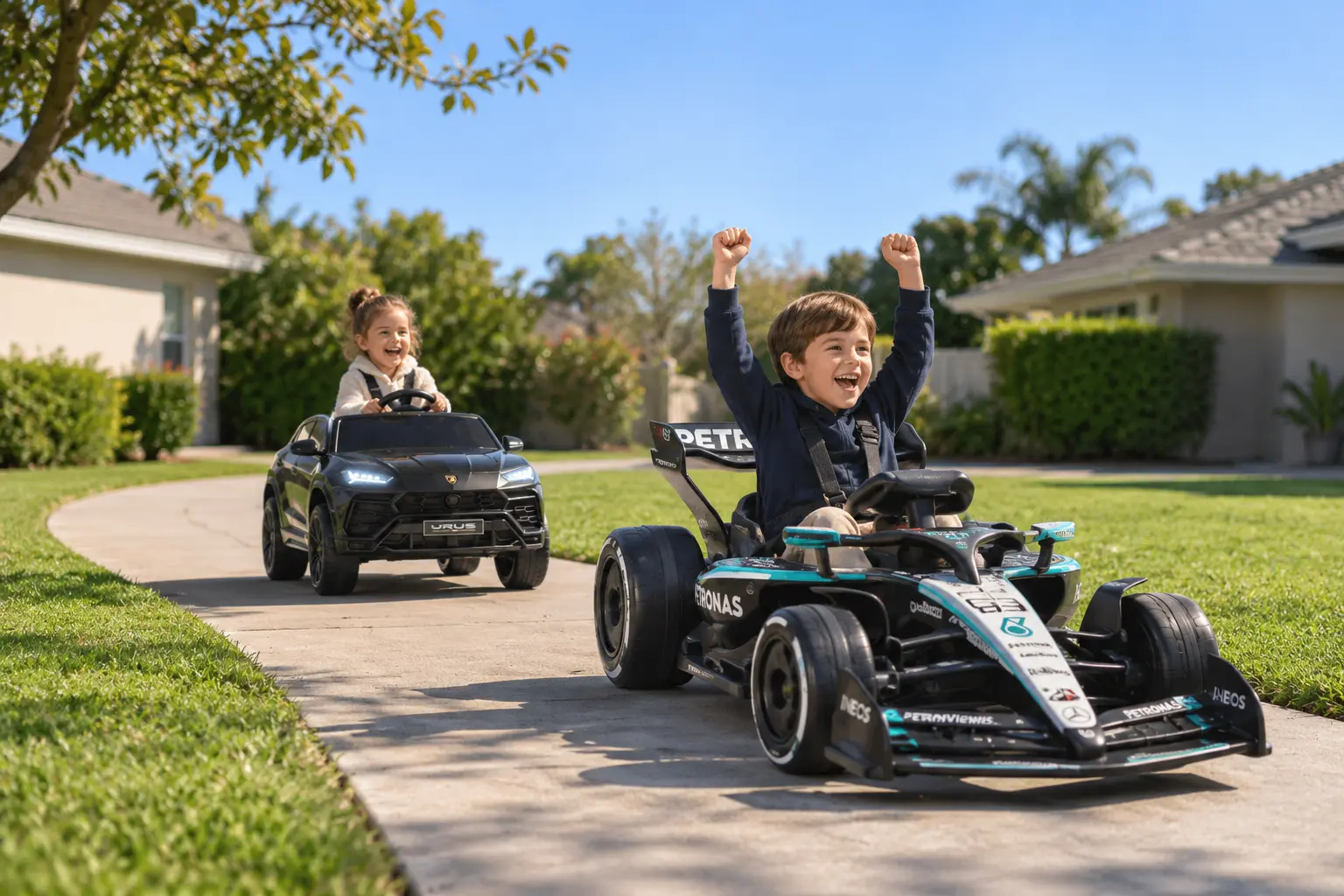
Ride-on cars with the same voltage can have very different age recommendations. There's no universal rule that all 12V models are suitable for ages 3–5 or that every 24V car is designed for children ages 5 and up.
When choosing a ride-on, it's best to start with the manufacturer's recommended age range. The vehicle's overall size, seat dimensions, weight capacity, maximum speed, and safety features all play a role in determining who it's designed for.
For children around ages 5–7, both 12V and 24V models may be worth considering. If your child enjoys relaxed rides around the driveway and still fits comfortably in a 12V car, there's little reason to upgrade just for the sake of higher voltage. On the other hand, a confident young driver who meets the age and weight requirements of a larger model may enjoy the added capabilities of a well-designed 24V or 36V ride-on.
3. Terrain
For smooth, level driveways and patios, a compact 12V vehicle is often more than sufficient. On short, dry, level grass, some 12V models also work well. Thick grass adds resistance, and performance becomes more dependent on motor capability, tires, gearing, and the rider’s weight.
Some 24V ride-ons are better equipped for demanding surfaces, but “24V” alone does not guarantee an off-road vehicle. Look for actual manufacturer statements about suitable ground conditions.
Buying tip: Match the product to the surface your child will use most—not the toughest surface you can imagine.
4. Battery Life and Charging
Does 24V Last Longer? Not necessarily. A 24V car can have a larger battery, but it can also use more energy while driving. Runtime depends on the battery’s stored energy, the motors’ energy use, speed setting, rider weight, and terrain.
5. Weight Capacity and Seating
Larger two-seater ride-ons and models with higher weight limits are often equipped with 24V systems because their size and load requirements may call for more driving power. However, two seats don't automatically mean 24V. Both 12V and 24V ride-ons are available in single-seat and two-seat designs.
6. Price and Long-Term Value
A higher-voltage model often costs more when it also includes a larger chassis, more capable motors, and upgraded components.
Before paying extra, consider your child's current abilities, the space available for riding, and how often the vehicle will be used. It's tempting to buy a powerful 24V model for a 3-year-old with the idea that they'll grow into it. But if the vehicle feels too fast, is difficult to control, or has a jerky start, your child may become uncomfortable and lose interest.
A ride-on that your child feels confident driving and enjoys using today may offer better value than a more powerful model they're not ready for.
Is a 24V Ride-On Safer Than a 12V Ride-On?
Neither voltage is automatically safer. Safety depends on choosing a vehicle intended for the child and using it correctly. A slow, stable car that fits its rider can be a better choice than a powerful model that is too large to control.
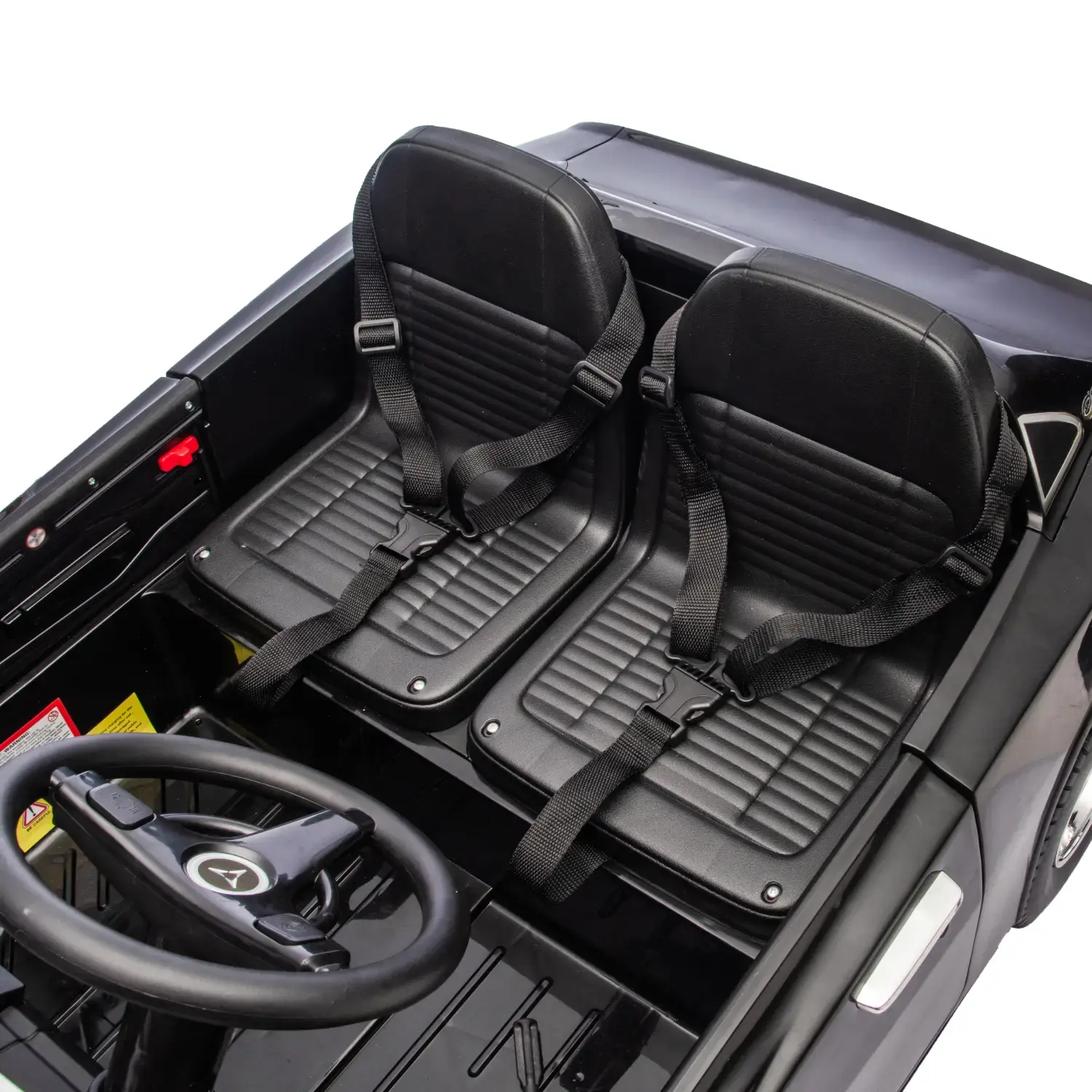
Before buying, check the safety features and specifications listed on the product page:
- Parental remote control: lets you steer, stop or override the child.
- Speed settings or a speed limiter: lets you cap the car as your child learns.
- Soft start: smooths acceleration so the car doesn't jolt forward.
- Seat belt and a stable body: check that the belt is adjustable and the car doesn't feel tippy.
- Reliable brakes: many cars brake when the pedal is released; confirm how yours stops.
- Weight and age limits: stay within the manufacturer's range.
At First Ride On, each product page provides key specifications and features to help parents compare models before buying. From speed settings and parental controls to weight limits and seating, you can review the details and find a ride-on that fits your child's needs.
Should You Choose a 12V or 24V Ride-On Car?
Choose a 12V Ride-On If…
Your child is learning to steer, most rides will take place on level pavement, and a compact, easy-to-manage vehicle suits your space. A properly rated 12V model can also be a sensible purchase when you want to keep the budget modest. Check the actual age and size fit before buying.
Choose a 24V Ride-On If…
Your child meets the manufacturer’s age and weight requirements, you want a larger vehicle or more driving capability, and your intended riding surfaces are approved for the model. Evaluate speed settings and physical fit—not just the voltage printed on the box.
Frequently Asked Questions About 12V vs 24V Ride-Ons
Can a 2-Year-Old Ride a 24V Ride-On Car?
Usually a 12V (or a 6V) used at the lowest speed with a parental remote. A 24V is generally too fast and heavy for a toddler. Make sure the car has soft start and a seat belt, and supervise every ride.
Is a 12V Ride-On Powerful Enough for Grass?
Sometimes. Some 12V ride-ons handle short, dry, level lawns, while others struggle. Grass height, rider weight, tire grip, and the drivetrain matter more than the voltage label alone. Check the product’s approved terrain.
Can I Upgrade My 12V to 24V, or Use a Power-Tool Battery?
We don't recommend it. The motors, wiring and controller are rated for 12V, and a swap can cause overheating, damage and safety risks for a young rider.
Will My Child Outgrow a 12V Too Fast?
Possibly, especially if they are tall, heavy or already confident. Weight limit and seat size matter more than age, so check them against your child now. Children around 5 and older often outgrow 12V models sooner.
Is 24V Really Faster? How Fast Is Too Fast?
A 24V is usually somewhat faster, but speed ranges overlap and speed settings vary by model. Too fast is whatever your child can't steer and stop with confidence, so prioritize a car with adjustable speed and a parental remote over a high top speed.
How Long Does the Battery Last on a Charge?
Most 12V and 24V ride-ons run about 1 to 2 hours and take around 8 to 12 hours to charge, but runtime depends on the Ah rating, motor power, terrain and your child's weight. See the battery section for care tips.